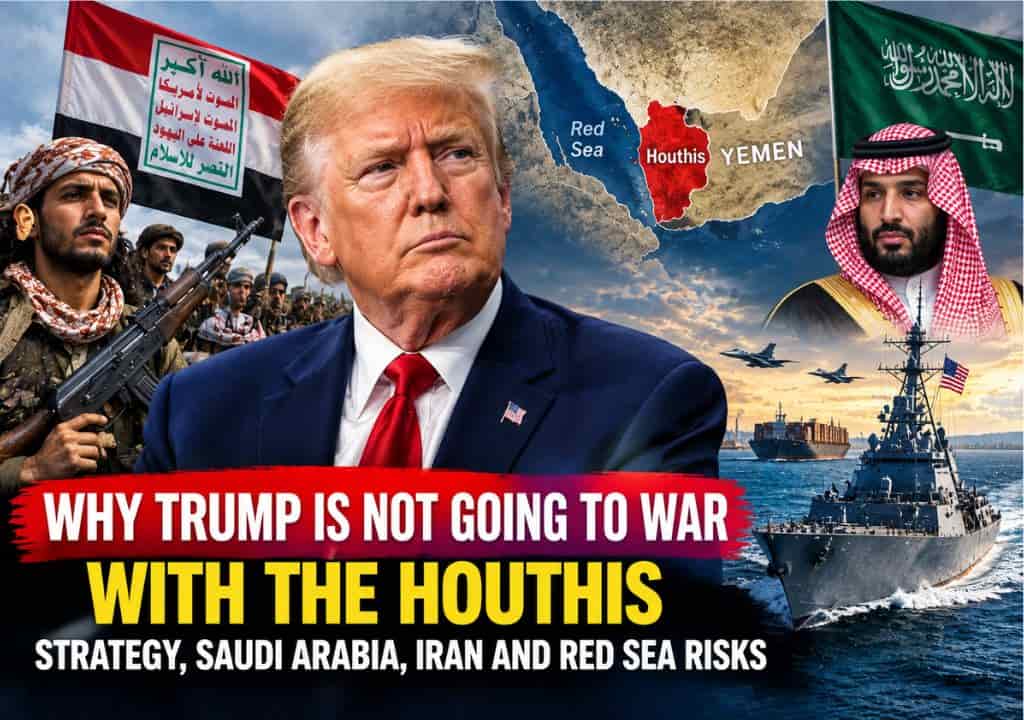
The question of why Trump is not going to war with the Houthis has become increasingly important as violence in the Middle East threatens regional security, international shipping and global energy markets. US President Donald Trump has faced pressure to support Saudi Arabia against Yemen’s Houthi movement, which has intensified attacks on strategic targets and threatened vital maritime routes.
However, the Trump war with the Houthis debate is more complicated than a straightforward decision to launch military strikes. Washington must weigh the security of its regional partners against the possibility of opening another military front in an already volatile region.
In September 2026, reports indicated that Saudi Crown Prince Mohammed bin Salman asked Trump for direct military assistance against the Houthis. The United States declined to commit to immediate direct strikes, although it continued to provide intelligence and targeting support, according to reporting by Reuters.
The situation subsequently became more dangerous. Houthi attacks on Saudi infrastructure increased, and Trump publicly warned the group while leaving open the possibility of American involvement.
This raises a critical question: Is Trump deliberately avoiding a war with the Houthis, or is Washington waiting for the right moment to intervene?
The answer involves military calculations, relations with Saudi Arabia, the confrontation with Iran, economic concerns and the uncertain consequences of another Middle East conflict.
Why Trump Is Avoiding a Direct War With the Houthis
The main reason Trump has been reluctant to commit American forces directly is that military intervention could create consequences extending far beyond Yemen.
A campaign against the Houthis might initially involve airstrikes against missile facilities, weapons depots and military installations. However, the group has demonstrated an ability to retaliate, disperse its forces and continue fighting despite years of conflict.
The Trump war with the Houthis question therefore involves more than whether the US military can strike targets. It also involves whether those strikes would achieve lasting security.
American officials must consider the possibility that a limited operation could develop into a prolonged campaign requiring additional aircraft, naval deployments, intelligence resources and air-defence systems.
There is also a diplomatic challenge. Washington wants to maintain its partnership with Saudi Arabia without automatically accepting responsibility for every military operation Riyadh considers necessary.
By withholding an immediate commitment to direct strikes, Trump has retained flexibility while continuing discussions with regional partners.
1. Trump Wants to Avoid Opening Another Military Front
One of the most significant factors behind the Trump war with the Houthis debate is the wider regional confrontation involving Iran and its partners.
The Houthis operate in Yemen, but their activities can influence developments across the Red Sea, the Gulf and the broader Middle East. Their weapons and military capabilities have also become part of the strategic competition between Iran and its regional adversaries.
If the United States launches a sustained campaign against the Houthis, the conflict could expand beyond Yemen. The group has threatened to retaliate against American interests if Washington joins attacks against it.
That possibility creates a difficult calculation for Trump. Direct intervention could demonstrate American support for Saudi Arabia, but it could also expose US personnel, naval vessels and regional facilities to additional threats.
The administration must decide whether attacking the Houthis would reduce the wider threat or create another opportunity for escalation.
For this reason, the Trump war with the Houthis issue is closely connected to the question of how Washington intends to manage the broader regional conflict.
2. Saudi Arabia Wants Support, but Washington Is Hesitant
Saudi Arabia is one of Washington’s important regional partners, and its security has long been a major consideration in American Middle East policy.
The renewed Houthi offensive has placed pressure on Riyadh. Attacks on airports, oil infrastructure and other strategic locations have highlighted vulnerabilities that could affect the kingdom’s economy and international reputation.
Reuters reported on September 11 that Crown Prince Mohammed bin Salman had sought American assistance. According to the report, Washington declined direct military action at that stage but offered intelligence-sharing and targeting support.
This approach allows the United States to help Saudi Arabia without immediately committing American forces to offensive operations.
However, the strategy carries risks. Saudi officials may believe that intelligence support alone is insufficient if Houthi attacks continue to damage infrastructure or threaten civilians.
The Trump war with the Houthis debate therefore also reflects a question about the limits of the US-Saudi security relationship: how much responsibility should Washington accept when its partner faces a serious military threat?
Saudi Arabia may prefer stronger American involvement, while Trump may want Riyadh and regional partners to assume greater responsibility for their own operations.
3. The Houthis Have Developed Significant Military Capabilities
Another reason a direct war with the Houthis could become difficult is the movement’s evolution from a local armed group into a force capable of threatening important regional targets.
The Houthis control substantial territory in Yemen and possess drones, ballistic missiles, cruise missiles and other weapons. Their capabilities have developed through years of fighting, external assistance and domestic weapons production.
Reuters reporting published on October 15 described how the movement’s military capabilities have improved, including its ability to assemble and deploy advanced weapons. Analysts cited in the report attributed part of this development to Iranian support and accumulated battlefield experience.
These capabilities make the Trump war with the Houthis question particularly challenging for American planners.
Airstrikes could destroy individual facilities, but they might not eliminate mobile launch systems, hidden weapons stocks or the movement’s ability to manufacture replacement equipment.
The United States would also have to consider the cost of defending against retaliation. Intercepting incoming drones and missiles can consume expensive defensive munitions, potentially creating an imbalance between the cost of an attack and the cost of stopping it.
The military challenge is therefore not simply to strike the Houthis. It is to determine whether strikes could produce a durable reduction in the threat.
4. Red Sea Shipping and Global Trade Are at Risk
The Red Sea crisis is another major factor influencing American decisions.
The Bab el-Mandeb Strait connects the Red Sea with the Gulf of Aden and provides a crucial passage for international shipping. Disruption in this area can affect vessels travelling between Europe and Asia, increasing transport costs and forcing some ships to take longer routes.
For the United States, protecting freedom of navigation is an important strategic objective. Yet a direct war with the Houthis could make shipping risks worse before improving them.
The group could respond to American strikes by threatening commercial vessels, ports or other maritime infrastructure. Even without a prolonged closure of shipping lanes, increased insurance premiums and uncertainty could affect businesses and consumers.
The Trump war with the Houthis debate therefore involves a difficult trade-off: military intervention could deter further attacks, but it could also trigger retaliation that disrupts the same trade routes Washington wants to protect.
The administration must weigh the immediate benefit of striking Houthi military assets against the possibility of a wider maritime crisis.
5. Iran Could Benefit From a Wider Conflict
The Houthis are aligned with Iran, although the movement has its own leadership, political objectives and interests in Yemen.
Iranian support has helped strengthen the group’s military capabilities, according to multiple reports and security analyses. Tehran’s relationship with the Houthis gives it influence in a strategically important area near major shipping routes.
A direct American campaign could deepen the confrontation between Washington and Tehran.
If the United States attacks the Houthis, Iran could use the resulting crisis to increase pressure on American partners or challenge US interests elsewhere. The precise response would depend on the circumstances, and it should not be assumed that every Houthi action is ordered directly by Tehran.
Nevertheless, the risk of escalation is central to the Trump war with the Houthis calculation.
Trump must consider whether military intervention would weaken Iran’s regional position or give Tehran additional opportunities to raise the costs of American policy.
This uncertainty helps explain why Washington may prefer intelligence assistance, deterrence and coordination with regional allies while retaining the option of direct military action.
6. The Economic Costs Could Be Significant
A prolonged military campaign would require substantial resources. Aircraft, naval vessels, surveillance systems, air-defense equipment and precision-guided weapons all involve financial and logistical costs.
Those expenses would come on top of the economic consequences of a wider regional conflict.
If Houthi attacks disrupt oil infrastructure or commercial shipping, energy markets could face additional uncertainty. Higher transportation costs can affect importers, manufacturers and consumers around the world.
Saudi Arabia also has economic priorities that depend on stability. The kingdom is seeking international investment and pursuing plans to diversify its economy beyond oil. Repeated attacks on airports and energy facilities could undermine confidence in its ability to provide a secure environment for businesses.
For Trump, the economic dimension of the Trump war with the Houthis debate is therefore significant. A military operation might protect important interests, but an escalating conflict could also damage trade, increase uncertainty and place further pressure on energy markets.
The administration must assess whether intervention would reduce these risks or intensify them.
7. Trump Is Keeping His Military Options Open
Avoiding immediate military action does not mean the United States has ruled out intervention.
Trump’s public statements in October showed that his position remained flexible. On October 10, he said the United States might join Saudi strikes against the Houthis. Days later, he criticised the group and suggested that its renewed attacks could be connected to Iran.
These statements indicate that the administration is weighing its options rather than announcing a permanent policy of non-intervention.
The Trump war with the Houthis debate could therefore change quickly if American personnel are attacked, international shipping faces a severe threat or Saudi Arabia requests further assistance.
Possible responses could range from increased intelligence support and defensive deployments to limited strikes or a broader military campaign. The actual decision would depend on developments on the ground and the administration’s assessment of the risks.
For now, it is important to distinguish between not launching a direct war immediately and promising never to intervene. They are not the same position.
What Could Happen Next?
Several possible developments could shape the future of the conflict.
First, Saudi Arabia and Yemeni government forces could intensify their operations against Houthi positions, with American intelligence and other forms of support continuing behind the scenes.
Second, further attacks on airports, oil facilities or commercial shipping could increase pressure on Trump to authorise direct US strikes.
Third, diplomatic efforts could attempt to limit the conflict and restore arrangements that reduce attacks on Saudi territory and international shipping.
A fourth possibility is escalation. If military operations lead to retaliatory attacks across the region, Washington could find itself under pressure to expand its involvement despite its initial reluctance.
The Trump war with the Houthis question will ultimately depend on how the administration balances deterrence, regional security and the risks of a wider confrontation.
Conclusion: Why Trump Is Not Going to War With the Houthis Yet
The most convincing explanation is that Trump is trying to balance American strategic interests against the costs and uncertainties of direct military intervention.
The United States has reasons to support Saudi Arabia, protect international shipping and deter attacks on regional partners. At the same time, a direct war with the Houthis could expand the confrontation with Iran, expose American forces to retaliation, increase military spending and create further disruption to global trade.
Washington’s earlier decision to withhold direct strikes, while continuing intelligence and targeting assistance, reflected an effort to support Saudi Arabia without immediately assuming the burden of another offensive campaign.
However, the situation has become more dangerous following renewed attacks on Saudi targets and Trump’s public warnings. His administration has left open the possibility of joining military operations, so it would be inaccurate to describe a future US intervention as ruled out.
Ultimately, the Trump war with the Houthis issue is about timing, strategy and consequences. Trump may continue to avoid direct war while relying on regional partners and indirect support, but a major attack on American interests or a further deterioration in regional security could change that calculation.
For the United States, Saudi Arabia, Yemen and the wider international community, the central challenge remains finding a way to protect security and shipping routes without triggering an even broader conflict.