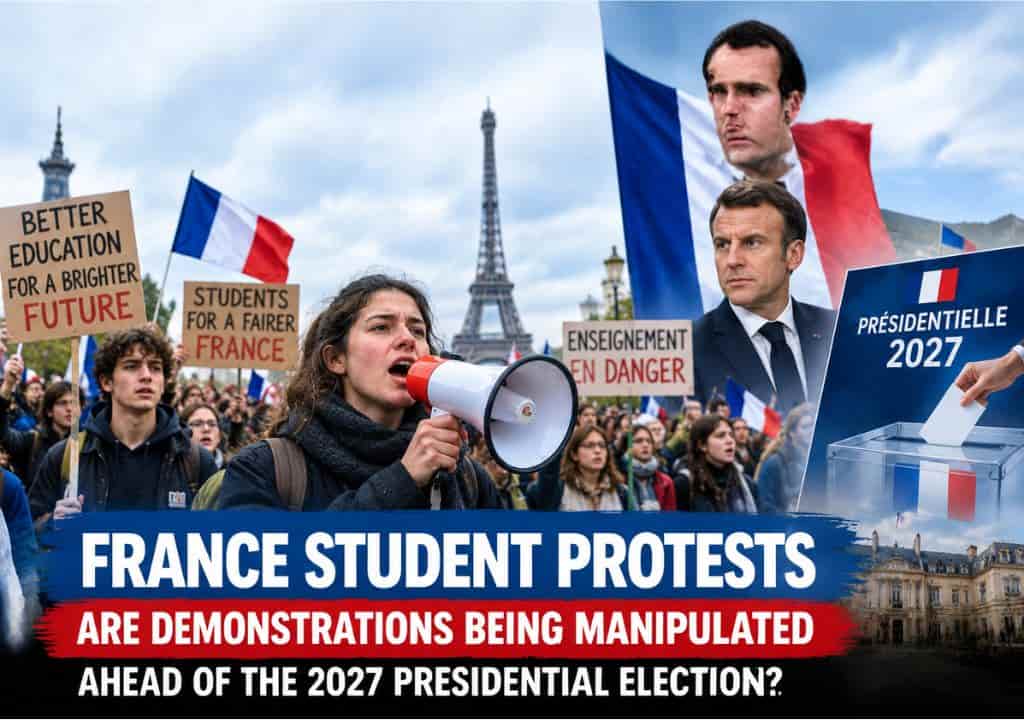
France student protests have become a major national issue as high school students and university communities demonstrate against teacher shortages, overcrowded classrooms and deteriorating school facilities. What began as a movement focused on educational conditions has developed into a wider political controversy, with government leaders accusing political groups of exploiting young people’s frustration ahead of France’s 2027 presidential election.
The demonstrations began in the Paris suburbs in September 2026 and spread to other parts of the country. Students have blocked school entrances, marched through city streets and demanded better-funded education services. Teachers, parents and trade unions have also joined parts of the movement.
The unrest has raised a central question: are France student protests being manipulated for political advantage, or are political parties simply responding to genuine public dissatisfaction?
French President Emmanuel Macron has acknowledged that students have legitimate grievances while arguing that political forces are taking advantage of the unrest. Prime Minister Sébastien Lecornu has also criticised political leaders whom he accuses of using the demonstrations for electoral purposes.
The left-wing party La France Insoumise (LFI), led by Jean-Luc Mélenchon, has rejected accusations that it organised the protests. The party says it supports students’ demands but denies being responsible for directing the movement.
As France approaches a presidential election expected in spring 2027, the dispute has become part of a broader debate about education, public spending, policing and political influence.
Why Are Students Protesting Across France?
The immediate causes of France student protests are rooted in complaints about the public education system. Students and educators have highlighted teacher shortages, missed lessons, overcrowded classrooms, ageing buildings and inadequate facilities during periods of extreme heat.
In some schools, students say the absence of teachers has disrupted their education and left them uncertain about completing the curriculum. Others have raised concerns about long school days, demanding timetables and the quality of learning environments.
These grievances have resonated beyond the original demonstrations. Students from different regions have joined protests, while education unions and parents have supported calls for improvements.
Reporting by Reuters on October 9 described a government commitment to deploy 3,000 qualified substitute teachers to schools experiencing serious staffing shortages. The announcement was presented as a response to one of the movement’s central demands. Student representatives and unions, however, questioned whether the measure would adequately address the scale and geographic distribution of teacher shortages.
The government faces a difficult budgetary environment, with pressure to control public spending while responding to demands for better services. Education has consequently become an important issue in the national debate.
Understanding these underlying problems is essential when examining France student protests. The existence of political arguments about who benefits from the demonstrations does not erase the educational concerns that brought many students into the streets.
Is the French Government Accusing Political Parties of Manipulation?
French officials have argued that some political groups are using the unrest to strengthen their positions before the next presidential election.
On October 14, the French government said Macron considered the students’ grievances legitimate but believed political forces were exploiting the movement. Lecornu has similarly criticised political leaders who, in his view, are using students’ anger to advance electoral campaigns.
Government figures and politicians on the right have directed accusations at La France Insoumise. They argue that the party’s involvement in public demonstrations and its support for student demands could help turn a school-focused movement into a broader challenge to the government.
Reuters reported earlier in October that a person close to the prime minister said intelligence officials had attributed the origins of the unrest to an organised effort involving LFI and allied groups. That account came through a source close to the government rather than a publicly presented, independently verifiable finding establishing that the party created the movement.
LFI rejected the allegation. The party has said it supports non-violent demonstrations and argued that the government’s response, including its rhetoric and police tactics, has intensified tensions.
The debate surrounding France student protests therefore includes competing accounts of political responsibility. Officials have made allegations about organisation and influence, while the party concerned denies orchestrating the movement.
It is important to distinguish political involvement from proof of manipulation. A party’s support for protesters, participation in a march or criticism of the government does not by itself demonstrate that it secretly created the protests.
What Role Does Jean-Luc Mélenchon Play?
Jean-Luc Mélenchon is one of France’s most prominent left-wing political figures and the leader of La France Insoumise. His party has criticised government policies and called for stronger public services, making education spending a natural point of political disagreement.
Mélenchon has publicly expressed support for the student movement. His comments have helped bring national attention to the demonstrations, but the government has interpreted this support as part of a wider attempt to influence the political debate.
LFI maintains that supporting a protest is not the same as organising it. The party has denied responsibility for initiating the France student protests and says students have their own reasons for demonstrating.
The distinction matters because political movements frequently attract support from parties, unions and advocacy groups after they begin. Such support may increase a movement’s visibility or influence, but establishing who initiated or directed a protest requires evidence about planning, coordination and decision-making.
Students are not necessarily acting on behalf of any political party simply because they share some of its criticisms of government policy. Their motivations may differ, and participants can support specific education reforms without endorsing a party’s broader platform.
The allegations against LFI remain contested. Readers should therefore assess statements from political leaders alongside independent reporting and verifiable evidence rather than treating accusations as established conclusions.
How the 2027 Presidential Election Shapes the Debate
France’s next presidential election is expected in spring 2027. With the political landscape fragmented and parties preparing for a major national contest, the France student protests have created a new point of debate about the government’s record and the future of public services.
Education policy can influence how voters assess governments and opposition parties. Teacher shortages, school conditions and inequality are concerns that extend beyond individual classrooms and connect to wider questions about public spending and social mobility.
The protests also give political parties opportunities to communicate their positions. Opposition politicians can present the unrest as evidence that government policies have failed, while officials can argue that demonstrations are being used to advance partisan goals.
Such political competition is normal in a democratic system. The more specific claim that a party deliberately manufactured or manipulated France student protests, however, requires stronger evidence than the fact that politicians have commented on them.
The election context also encourages scrutiny of how public statements are framed. Claims about the protests’ origins may influence perceptions of both students and political groups, making accuracy and clear attribution especially important.
For now, the demonstrations are one element of a wider political debate. Their eventual influence on the election cannot be reliably determined from current events alone.
Have the Protests Become Violent?
Although many demonstrations have been peaceful, some have involved clashes, vandalism, fires and confrontations with police. Authorities have reported arrests and injuries, while students, unions and rights advocates have raised concerns about the use of force.
Reuters reported on October 6 that demonstrations had spread across multiple French cities and that police used tear gas and water cannons in some locations. The protests have also disrupted school operations, with blockades preventing students and staff from entering certain buildings.
The violence has intensified disagreements about the government’s response. Officials have condemned attacks, damage to schools and injuries to police officers. Critics have questioned whether police tactics have been proportionate, particularly in incidents involving minors.
These issues should be considered separately from claims of political manipulation. Violence by some individuals does not establish that the entire student movement is coordinated by a political party. Similarly, allegations of excessive force require examination of the particular incidents and available evidence.
France student protests have included different participants, locations and circumstances. Some students are focused on education policy, while other individuals may become involved in confrontations or property damage. Reporting should distinguish these groups rather than portray every demonstration as identical.
Authorities and protest organisers both face pressure to prevent further injuries and ensure that demonstrations remain peaceful.
What Role Does Social Media Play?
Social media has helped students share footage, discuss school conditions and organise demonstrations across France. Videos from protests can provide immediate accounts of events that might otherwise receive limited coverage.
Digital platforms also allow participants to connect with students in other cities and build a sense of shared purpose. Images of school blockades and demonstrations have helped the movement gain national visibility.
However, the same platforms can spread misleading captions, edited clips and unverified claims. A video showing a confrontation may omit what happened before it, while a post alleging that a party secretly organised a demonstration may circulate without supporting evidence.
In discussions of France student protests, social media evidence should therefore be checked against the date, location, original footage and reporting from credible news organisations. A widely shared post is not automatically reliable.
There is also a difference between using online platforms to coordinate a demonstration and using them to manipulate participants. Establishing manipulation would require evidence about deceptive tactics, false information, covert coordination or other specific conduct.
Social media is an important part of the story, but its role should be assessed through verifiable examples rather than broad assumptions about young people or online activism.
Are Foreign Governments Behind the Protests?
Concerns about foreign interference have become part of France’s wider political debate ahead of the 2027 election. France and other European countries have previously raised concerns about disinformation operations and attempts to influence public opinion.
However, those broader concerns do not establish that a foreign government created or directed the current France student protests. The reporting reviewed for this article does not establish that a foreign state organised the demonstrations.
Claims of foreign orchestration should be supported by identifiable evidence, such as documented coordination, verified funding links or findings from a credible investigation. Political speculation and the circulation of online content are not sufficient on their own.
It is also important to distinguish foreign interference from ordinary international attention. News coverage, public commentary and solidarity messages from people outside France do not necessarily indicate an organised influence operation.
The available evidence points to domestic educational grievances and a contested political debate about the movement’s direction. If credible evidence of foreign involvement emerges, it should be reported with clear attribution and details about what investigators have established.
Until then, claims that France student protests are being directed from abroad should not be presented as fact.
What Happens Next?
The immediate challenge for the French government is to respond to students’ concerns while maintaining public safety and keeping schools operating. The promised deployment of 3,000 qualified substitute teachers is one measure, but education unions have questioned whether it will be enough to resolve persistent staffing problems.
Further negotiations with student organisations, teachers and parents could help identify which reforms are possible in the short term and which require longer-term funding decisions.
Political tensions are likely to remain part of the debate as parties position themselves ahead of the presidential election. Government officials may continue to question the role of opposition groups, while LFI and other critics are likely to emphasise the underlying education crisis.
The future of France student protests will depend on several factors: whether schools receive meaningful support, whether demonstrations remain peaceful, how authorities respond to public criticism and whether students believe their demands are being addressed.
Reliable reporting should continue to distinguish confirmed developments from allegations about political motives. Statements from officials, opposition parties and student groups are important, but they should be weighed alongside independent reporting and documented evidence.
Conclusion
France student protests have developed from complaints about teacher shortages, crowded classrooms and deteriorating school conditions into a wider political controversy ahead of the 2027 presidential election.
President Emmanuel Macron and Prime Minister Sébastien Lecornu have argued that political forces are exploiting students’ frustration. La France Insoumise has rejected accusations that it organised the demonstrations and says it supports students’ demands rather than directing the movement.
The available reporting confirms that the protests have real education-related grievances behind them. It also documents political disputes, clashes in some locations and concerns about police conduct. However, allegations of deliberate political manipulation must be distinguished from proven facts, and the reviewed evidence does not establish that a foreign government organised the demonstrations.
The key question is not simply whether political parties are involved, but what evidence supports claims about their role. As the election approaches, accurate reporting on France student protests will be essential to understanding the movement without overstating what is known.