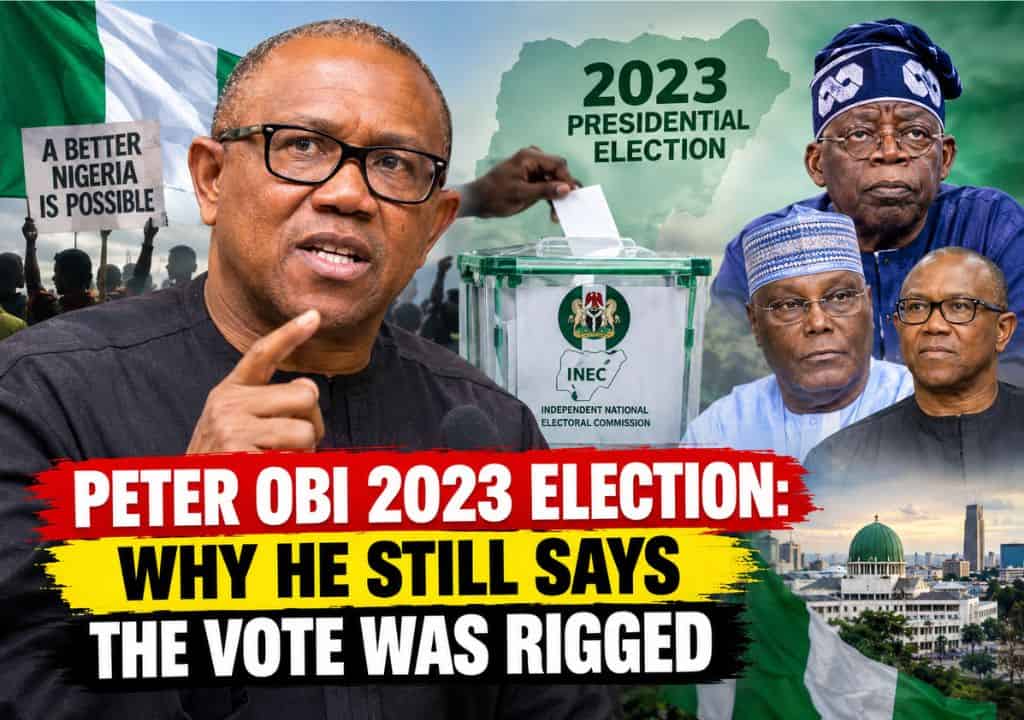
The Peter Obi 2023 election controversy has returned to Nigeria’s political debate after the opposition politician reiterated his belief that he won the country’s last presidential election, despite acknowledging in a BBC interview that he had no evidence to substantiate that claim.
Obi, a former governor of Anambra State, contested the February 2023 presidential election as the Labour Party candidate. He finished third behind Bola Ahmed Tinubu of the All Progressives Congress (APC) and Atiku Abubakar of the Peoples Democratic Party (PDP).
The Peter Obi 2023 election dispute has remained politically significant because the candidate attracted substantial support from young Nigerians and voters seeking changes to governance, employment opportunities and public accountability.
During the BBC interview, Obi maintained that he had won the election, even after being questioned about the evidence supporting his assertion. His comments prompted criticism from the ruling party and renewed discussion about Nigeria’s electoral institutions.
However, the Peter Obi 2023 election controversy requires careful examination. The Independent National Electoral Commission (INEC) declared Tinubu the winner, and Nigeria’s courts subsequently upheld that outcome. At the same time, independent reporting identified discrepancies in some local results, raising broader questions about transparency and public confidence in the electoral process.
The central issue is how Obi’s renewed statements, the court decisions and documented concerns about election administration fit into Nigeria’s preparations for the 2027 presidential contest.
What Did Peter Obi Say About the 2023 Election?
The latest Peter Obi 2023 election debate intensified after the politician spoke with the BBC about his claim that he had won the presidential contest.
When asked whether he still stood by his position, Obi said he did. When pressed about whether he had evidence to prove his claim, he acknowledged that he did not have evidence to support it, while continuing to insist that he had won.
The exchange attracted attention because it raised a distinction between a politician’s belief about an election and the evidence required to establish a legal challenge.
Obi had previously challenged the declared result through the courts, arguing that irregularities and other alleged violations undermined the outcome. Those legal challenges did not succeed.
The Peter Obi 2023 election remarks therefore reopened a dispute that had already passed through Nigeria’s judicial system.
Supporters may view Obi’s continued criticism as a demand for greater electoral accountability. Critics, including representatives of the ruling party, argue that allegations should be supported by verifiable evidence, particularly after the courts have ruled.
Obi’s latest comments do not, by themselves, establish that the national election result was manipulated or that he received more votes than the official figures show.
What Were the Official Results of Nigeria’s 2023 Presidential Election?
Nigeria held its presidential election on February 25, 2023. INEC declared Bola Tinubu the winner after the nationwide vote count.
The official results were:
Bola Ahmed Tinubu, APC: 8,794,726 votes
Atiku Abubakar, PDP: 6,984,520 votes
Peter Obi, Labour Party: 6,101,533 votes
These figures placed Obi third in the official national result.
The Peter Obi 2023 election dispute began almost immediately, with Obi and other opposition figures challenging aspects of the process. Their objections included allegations involving the transmission and collation of results and the administration of electoral procedures.
For many voters, the controversy was connected to expectations surrounding technological improvements intended to make election results more transparent. Disputes over result transmission and collation became central to public discussion about whether the electoral system had delivered the level of transparency voters expected.
Nevertheless, the official figures remained the legally recognised result after the judicial challenges were dismissed.
Understanding the Peter Obi 2023 election controversy requires separating three things: the result declared by INEC, allegations raised by political parties and independent findings about particular aspects of election administration.
What Did Nigeria’s Courts Decide?
After INEC declared Tinubu the winner, Obi filed a petition challenging the outcome.
In September 2023, the Presidential Election Petition Court dismissed his petition, finding that he had not established the grounds necessary to overturn the declared result.
The Supreme Court subsequently upheld Tinubu’s victory in October 2023, dismissing appeals brought by Obi and Atiku.
These decisions are central to the Peter Obi 2023 election story because they determined the legal status of the presidential result.
The courts considered the arguments and evidence presented in the cases. Their decisions meant that the official declaration of Tinubu as president remained in force.
However, a judicial ruling should be described precisely. The courts’ rejection of a petition means that the petitioners did not establish sufficient legal grounds to obtain the remedy they sought. It does not automatically mean that every administrative decision made during an election was flawless.
Similarly, the existence of irregularities in a particular location does not, on its own, establish that the nationwide outcome should be overturned.
The Peter Obi 2023 election debate therefore continues largely as a political argument about public trust, even though the legal challenge to the result was unsuccessful.
BBC Investigation Found Discrepancies in Rivers State
One important element of the Peter Obi 2023 election controversy is a BBC investigation published in May 2023.
The investigation examined polling-station result sheets in Rivers State and identified significant discrepancies between the figures recorded on some available tally sheets and the totals officially announced at the state level.
The BBC’s examination suggested that Tinubu’s official vote total in the state was higher than the organisation’s tally of the polling-station sheets it was able to examine, while Obi’s total was lower.
The investigation also acknowledged limitations. Some result sheets were missing, some were difficult to read, and the BBC could not verify every polling station. Its findings did not establish that the discrepancies were sufficient to change the national outcome.
These findings matter because they show why election transparency remains a legitimate subject of scrutiny. Comparing polling-station records with officially declared totals is an important way to investigate possible irregularities.
At the same time, the BBC investigation should not be interpreted as proof that Obi won the national election. Its findings concerned specific results in Rivers State and were not sufficient to establish a different national winner.
The Peter Obi 2023 election controversy therefore involves both an unsuccessful legal challenge and documented questions about particular local results. Reporting should acknowledge both without treating one as proof of the other.
Why Has the Controversy Continued?
The Peter Obi 2023 election debate has continued partly because the 2023 campaign mobilised voters who wanted political change.
Obi attracted support from many younger Nigerians and voters frustrated by unemployment, inflation, insecurity and concerns about public accountability. His campaign presented him as an alternative to the established political parties that have dominated Nigerian politics.
For some supporters, disputes over the election became a broader symbol of concerns about democratic representation and the credibility of public institutions.
Nigeria has a long history of disputed elections, court challenges and public debate about vote counting. As a result, allegations of irregularities can continue to influence political discussion long after the legal process has concluded.
However, continued public disagreement does not establish that the result was changed by fraud. Reliable conclusions require evidence that can be independently checked.
The Peter Obi 2023 election issue is therefore likely to remain part of Nigeria’s political conversation as parties and candidates prepare for the next presidential contest.
Peter Obi’s Plans for Nigeria’s 2027 Election
The latest discussion about the Peter Obi 2023 election claim is also connected to his political ambitions for 2027.
Obi is now associated with the Nigeria Democratic Congress (NDC), after previously contesting the presidency under the Labour Party banner. He has indicated that he intends to seek the presidency again.
In his BBC interview, Obi discussed several issues he says he would prioritise if elected, including insecurity, corruption and economic policy.
He argued that Nigeria could tackle insecurity more effectively through determined leadership and direct engagement with affected communities. He also discussed the need to address corruption and improve government accountability.
Obi has also spoken about restoring fuel subsidies while tackling corruption associated with the subsidy system. Such a proposal would have important fiscal implications and would need to be assessed alongside its potential effects on household costs, government spending and public services.
These proposals will require detailed examination as the 2027 election approaches. Voters will need to consider how candidates intend to fund their policies, implement reforms and measure their results.
Although the Peter Obi 2023 election controversy continues to attract attention, his future campaign will also be judged on policy proposals and plans for addressing Nigeria’s current challenges.
What Does the Dispute Mean for Nigeria’s Democracy?
The Peter Obi 2023 election dispute highlights the importance of trust in electoral institutions.
For democratic elections to command public confidence, voters need accessible information about how ballots are counted, how results are transmitted and how complaints are investigated.
Election authorities can help strengthen confidence by publishing complete result records, explaining discrepancies promptly and ensuring that procedures are applied consistently. Political parties also have a responsibility to present evidence when alleging wrongdoing and to respect lawful dispute-resolution processes.
Independent journalism plays an important role by checking official figures against available records and explaining the limitations of its findings. The BBC’s Rivers State investigation demonstrates how published polling-station records can support scrutiny, while also showing why incomplete data must be acknowledged.
The Peter Obi 2023 election debate should not be reduced to competing political statements. It also raises practical questions about the reliability of electoral technology, the quality of result collation and the effectiveness of institutions responsible for resolving disputes.
For Nigeria’s next election, transparent procedures and credible explanations could help reduce uncertainty and improve public confidence, regardless of which party ultimately wins.
Conclusion: Peter Obi 2023 Election Claims and the Road to 2027
The Peter Obi 2023 election controversy has resurfaced after the opposition politician reiterated his belief that he won the presidential vote, while acknowledging that he had no evidence to substantiate that claim in his recent BBC interview.
INEC declared Bola Tinubu the winner, and Nigeria’s courts upheld the result after dismissing the challenges brought by Obi and Atiku Abubakar.
At the same time, a BBC investigation identified discrepancies in some Rivers State results. Those findings raised questions about electoral transparency but did not establish that the national outcome should have been different.
The distinction is important: allegations deserve examination, documented irregularities deserve scrutiny, and claims about the overall result require evidence strong enough to support them.
As Nigeria approaches the 2027 presidential election, the Peter Obi 2023 election dispute will likely remain part of political debate. The broader challenge is to ensure that future elections are administered transparently, disputes are addressed through credible procedures and public officials are held accountable.
Ultimately, confidence in democracy depends not only on who wins an election, but also on whether citizens can understand and trust the process through which that result is reached.