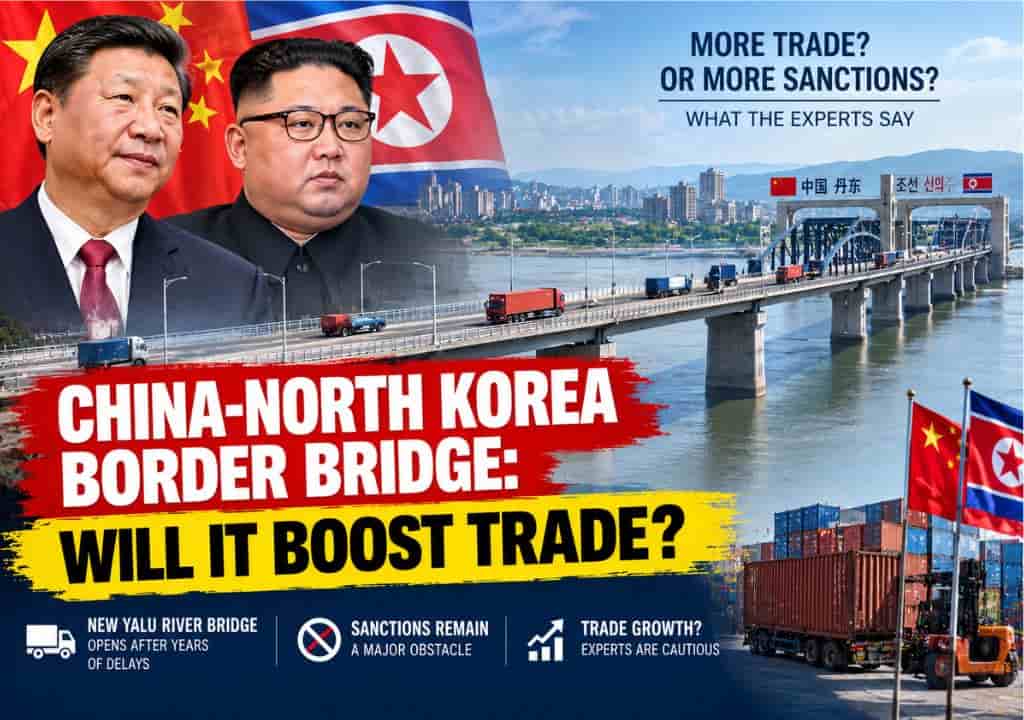
The China-North Korea border bridge connecting Dandong in northeastern China with Sinuiju in North Korea has officially opened, marking a new development in economic and diplomatic relations between the neighbouring countries. However, despite official promises of stronger trade and cooperation, experts caution that the infrastructure project may not immediately produce a major increase in cross-border commerce.
The New Yalu River Bridge opened on October 15, 2026, following more than a decade of delays. The four-lane crossing, approximately three kilometres long, spans the Yalu River, which forms a significant section of the border between China and North Korea.
Officials from both countries described the opening as an important step towards closer economic cooperation. Chinese Premier Li Qiang said the bridge would promote trade and strengthen ties, while North Korean Premier Pak Thae-song expressed confidence that it would contribute to prosperity and cooperation.
Nevertheless, the China-North Korea border bridge faces challenges that cannot be solved by construction alone. International sanctions, North Korea’s security priorities, political considerations and its complicated relationships with China and Russia will influence how extensively the new crossing is used.
For businesses and residents in the Chinese border city of Dandong, the bridge offers potential opportunities. For North Korea, it could improve the movement of permitted goods and strengthen access to its largest trading partner. Whether these possibilities translate into substantial economic gains remains uncertain.
What Is the New Yalu River Bridge?
The New Yalu River Bridge is a major road connection designed to improve transportation between Dandong, in China’s Liaoning province, and Sinuiju, in North Korea’s North Pyongan province.
The China-North Korea border bridge was intended to strengthen commercial connections and reduce pressure on the older Sino-Korean Friendship Bridge, which has long served as a principal route for road and rail traffic between the two countries.
Construction began in 2011, and China completed its side in 2014. However, the project remained unused for years because the necessary roads, customs facilities and supporting infrastructure on the North Korean side were not ready.
The delay reflected more than a construction problem. Relations between Beijing and Pyongyang became strained after North Korea’s nuclear tests and China’s support for United Nations sanctions targeting its weapons programmes.
North Korea’s eventual completion of the necessary infrastructure allowed the China-North Korea border bridge to move from a long-delayed project to an operational crossing.
The new route is expected to improve freight movement and offer additional capacity for commercial vehicles. Its four lanes provide more road space than the older bridge, where vehicles must share a single-lane road alongside railway infrastructure.
However, the full economic benefit will depend on traffic volumes, customs arrangements and the ability of businesses to trade within the limits of international sanctions.
Why Experts Say Trade May Not Increase Dramatically
Although the opening of the China-North Korea border bridge creates a new transport option, analysts argue that limited infrastructure has not been the only obstacle to stronger economic ties.
Christopher Green, a senior consultant on the Korean Peninsula at the International Crisis Group, told Al Jazeera that China-North Korea trade is fundamentally driven by politics. In his assessment, the absence of additional cross-border routes is not the main barrier to greater trade.
That distinction is important. A bridge can reduce transport bottlenecks, but it cannot independently change government policies, remove sanctions or guarantee that companies will have permission to trade particular goods.
North Korea’s leadership also places significant emphasis on national security and political control. Its approach to international commerce has therefore differed from that of countries seeking broad integration into global markets.
The China-North Korea border bridge could facilitate greater trade if both governments decide to expand commercial cooperation. Without such a political decision, the additional road capacity may remain underused.
Analysts also point to previous development initiatives that failed to deliver their expected results. The Hwanggumpyong special economic zone, a joint Chinese-North Korean project near Dandong, is frequently cited as an example of how infrastructure and investment plans can stall when political priorities change.
The experience suggests that the success of the China-North Korea border bridge will depend on sustained cooperation, not simply the completion of construction.
China Remains North Korea’s Most Important Trading Partner
China has long been North Korea’s principal economic partner, supplying a wide range of goods and providing an essential connection to international markets.
According to figures cited by Al Jazeera from China’s General Administration of Customs, bilateral trade reached approximately $2.74 billion in 2025, an increase of 25 percent from the previous year. Trade continued to grow in the first half of 2026, reaching around $1.5 billion, according to the same report.
Reuters separately reported that Chinese exports to North Korea rose to approximately $2.3 billion in 2025, up 25 percent year on year. These figures refer to Chinese exports, rather than the total value of trade in both directions.
Despite the recovery, trade remains below the levels recorded during much of the 2010s, before sanctions and pandemic-related restrictions disrupted economic activity.
The China-North Korea border bridge could help improve this situation by offering a more efficient route for permitted imports and exports. Faster transport and improved logistics could reduce some of the practical costs associated with moving goods across the border.
However, the potential increase should be viewed in context. China’s total trade with the world is enormous, while North Korea represents a very small share of Chinese international commerce.
For North Korea, by contrast, the relationship is much more consequential. The Associated Press reported that China accounted for about 98 percent of North Korea’s external trade in 2025.
This imbalance gives Beijing considerable economic importance to Pyongyang, but it also creates a concern for North Korean leaders: closer commercial integration could increase dependence on China.
How International Sanctions Affect the Bridge
United Nations sanctions imposed in response to North Korea’s nuclear and missile programmes remain a major factor shaping its international economic relationships.
The restrictions cover particular exports, imports, financial activities and forms of cooperation. Their scope depends on the relevant resolutions and applicable national enforcement measures.
The China-North Korea border bridge does not change these legal requirements. Opening a new route does not make prohibited goods lawful, nor does it automatically authorise commercial activities restricted by sanctions.
Some analysts have raised concerns that expanded transport infrastructure could make it easier to move goods that violate sanctions. Others note that a formal border crossing with customs controls could make certain movements more visible to authorities than informal or illicit transfers.
The actual effect will depend on how the crossing operates, what goods are transported and how effectively customs and enforcement agencies implement the relevant rules.
For businesses, uncertainty about sanctions compliance can discourage investment and complicate decisions about suppliers, payments and transport arrangements.
Consequently, even if the China-North Korea border bridge reduces logistical costs, companies will still need to comply with applicable restrictions. This limits the range of activities that can expand legally and may prevent the bridge from becoming the commercial breakthrough that officials hope for.
China and North Korea Seek Closer Political Relations
The opening of the China-North Korea border bridge comes amid renewed diplomatic engagement between the two governments.
Chinese President Xi Jinping and North Korean leader Kim Jong Un have held several meetings since 2018. Their latest reported summit, in June 2026, included pledges to strengthen cooperation across areas such as trade, agriculture, science, technology and defence.
For China, deeper engagement helps maintain its position as North Korea’s most important economic partner. Beijing also has an interest in stability along its northeastern border and in maintaining influence over developments on the Korean Peninsula.
North Korea, meanwhile, can benefit from access to Chinese goods, investment and diplomatic support. Greater trade could help supply its domestic economy, although the extent to which ordinary households would benefit depends on how goods and income are distributed within the country.
The China-North Korea border bridge therefore carries both practical and symbolic significance. It demonstrates that both governments are prepared to move forward with a project that remained stalled for years.
Still, the long delay is a reminder that political relations can limit economic cooperation. The opening signals an opportunity for closer ties, but it does not guarantee a lasting change in either country’s economic strategy.
Why North Korea’s Relationship With Russia Matters
North Korea has also strengthened its relationship with Russia, adding another dimension to its diplomatic and economic calculations.
The two countries have expanded cooperation, including military ties connected to Russia’s war against Ukraine. North Korea has deployed troops to support Russia’s war effort, according to reporting by international news organisations, while Moscow and Pyongyang have deepened their strategic relationship.
In September 2026, North Korea and Russia opened a road bridge across the Tumen River, creating another physical connection between North Korea and a major partner.
The opening of the China-North Korea border bridge soon after that development highlights the importance of regional transport links, but it also reflects competition for influence.
China remains economically indispensable to North Korea in ways that Russia may not be able to replace. At the same time, Russian support gives Pyongyang another relationship through which to pursue economic and strategic objectives.
North Korea can seek benefits from both countries while attempting to avoid excessive dependence on either one.
For Beijing, stronger cooperation through the China-North Korea border bridge could help reinforce its role in the region. But the extent of that influence will depend on North Korea’s willingness to expand economic ties and on the priorities both governments place on security.
Could Dandong Benefit From the New Bridge?
Dandong has long served as a gateway for trade between China and North Korea. The opening of the China-North Korea border bridge has raised hopes that additional freight traffic could stimulate local businesses, logistics services and investment.
The city has developed commercial areas and tourism facilities near the new crossing. Some residents and businesses hope greater cross-border activity will create jobs and increase demand for transport, accommodation and retail services.
However, the experience of the past decade has made local expectations more cautious. Reuters reported before the opening that Dandong’s economy had not enjoyed a major revival despite recovering trade, and that some commercial developments near the bridge remained quiet.
The reason is straightforward: an increase in freight capacity does not automatically generate widespread local prosperity. The impact depends on whether companies actually use the crossing, whether trade generates additional jobs and whether local businesses can participate in the resulting activity.
The China-North Korea border bridge could support economic growth if freight traffic rises consistently and new commercial opportunities emerge. But its contribution to Dandong’s economy may be limited if trade remains concentrated among established firms or if political restrictions continue to constrain business.
Tourism is another uncertain area. North Korea’s restrictions on foreign visitors mean that the bridge’s opening does not automatically create a new route for ordinary Chinese tourists to visit the country.
What Should Observers Watch Next?
The immediate test for the China-North Korea border bridge will be whether it develops into a regularly used commercial route rather than remaining primarily a symbol of improved relations.
Several indicators will help clarify its economic significance.
First, official freight and customs data can show whether cross-border traffic increases after the opening. Second, the range of goods moving through the crossing will help reveal whether trade is expanding into new areas or simply shifting from the older bridge.
Third, further agreements between Beijing and Pyongyang could indicate a political decision to deepen economic cooperation. Fourth, sanctions enforcement and North Korea’s relationship with Russia will continue to shape the environment in which trade develops.
Finally, the benefits for local residents will matter. Higher trade figures do not necessarily translate into higher household incomes or better living standards, particularly where economic activity is tightly controlled.
The China-North Korea border bridge may become an important part of the region’s transport network, but its long-term value will be determined by actual use, policy choices and the durability of bilateral cooperation.
Conclusion
The opening of the China-North Korea border bridge marks an important infrastructure milestone after years of delays. The new crossing between Dandong and Sinuiju offers additional road capacity and could improve the movement of permitted goods between North Korea and its largest trading partner.
Yet the economic outlook remains uncertain. International sanctions, North Korea’s security priorities, political sensitivities and its growing relationship with Russia all influence how far trade can expand.
For China, the bridge is an opportunity to strengthen its economic and diplomatic position. For North Korea, it offers improved access to supplies and commercial connections without requiring an immediate change to its economic model.
Whether the project produces a significant trade boom will depend on decisions made in Beijing and Pyongyang, as well as the practical operation of the crossing. The China-North Korea border bridge has created new possibilities, but it has not removed the political and economic barriers that have shaped bilateral trade for years.