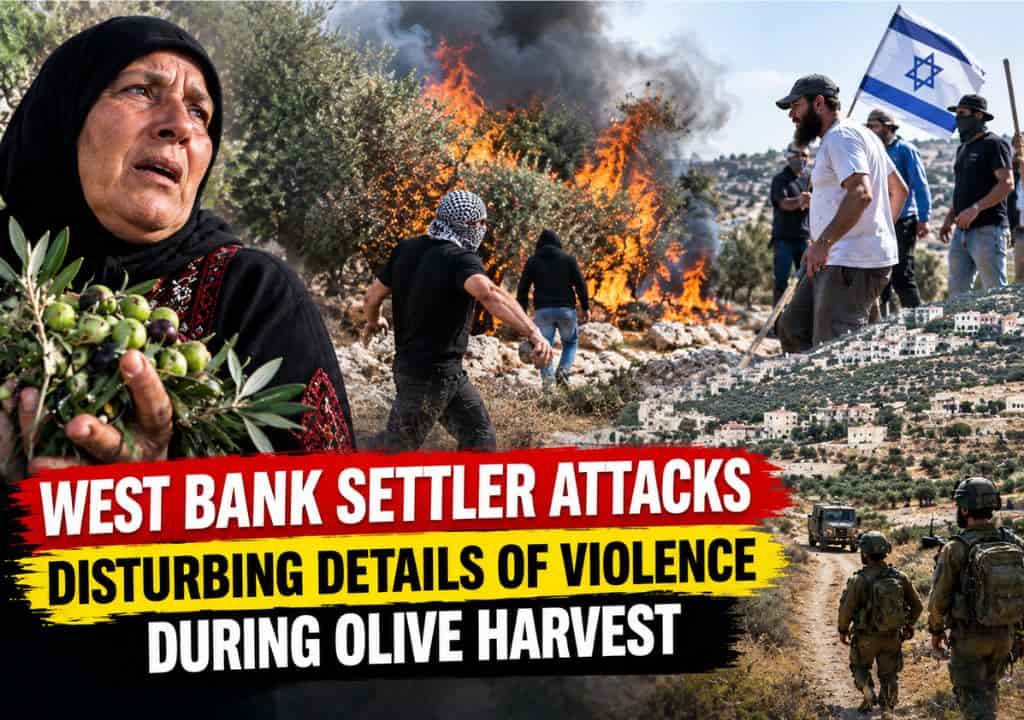
West Bank settler attacks have intensified during the 2026 olive harvest, with reports of burned olive trees, assaults on Palestinian residents and injuries to journalists documenting the violence. The latest incidents, reported on October 16, have renewed concerns about the safety of Palestinian communities, the protection of agricultural livelihoods and the accountability of those responsible for attacks in the occupied West Bank.
According to reporting by Reuters and the Associated Press (AP), Israeli settlers attacked Palestinian villages during the annual harvest, damaging property and injuring residents. The violence has drawn renewed attention to a longstanding problem in the territory, where disputes over land, settlement expansion, movement restrictions and personal security affect everyday life.
The latest West Bank settler attacks are particularly concerning because they occurred during a critical period for Palestinian farming families. Olive cultivation is not simply an agricultural activity in the West Bank. It provides income, supports local economies and connects many families to land cultivated across generations.
The incidents raise urgent questions about whether farmers can safely reach their groves, whether damaged trees can be restored and what steps authorities will take to prevent further violence.
What Happened in the Latest West Bank Settler Attacks?
On October 16, Reuters reported that approximately 80 masked Israeli settlers attacked the Palestinian village of Abu Falah, near Ramallah, during the olive harvest.
Witnesses described settlers setting olive trees on fire and throwing rocks at Palestinian residents. Some attackers were reportedly armed. The incident resulted in injuries and damage to agricultural property, according to the report.
The Associated Press also reported attacks across several Palestinian villages, including incidents involving burned vehicles and olive trees. The Palestinian Red Crescent Society reported six injuries connected to attacks in Abu Falah. AP reported that a 63-year-old woman and a 40-year-old man were hospitalized after being beaten.
The events illustrate the immediate dangers associated with West Bank settler attacks, particularly when residents are working outdoors or attempting to protect their homes and property.
Journalists covering the violence were also affected. Reuters reported that Washington Post photojournalist Heidi Levine was kicked and pushed to the ground during the attack. She was hospitalized and reported to be in stable condition.
Incidents affecting journalists matter beyond the injuries suffered by individual reporters. Journalists and photographers provide evidence of events that might otherwise remain undocumented, helping the public and investigators understand what happened.
The latest West Bank settler attacks therefore raise concerns not only about residents’ safety but also about the ability of the media to report on violence without intimidation or physical harm.
Why the Olive Harvest Has Become a Flashpoint
The olive harvest is one of the most important agricultural seasons for many Palestinian communities. Families depend on olive trees for olives, olive oil and other products that can be sold locally or in wider markets.
Harvesting also requires farmers to reach groves that may be located far from their homes or close to settlements, roads and contested areas. When violence, threats or movement restrictions prevent access, families can lose valuable income even if their trees remain standing.
The impact of West Bank settler attacks can extend well beyond the day an incident occurs. Burning an established olive tree may destroy years of growth and reduce future harvests. Damaging a vehicle can prevent farmers from transporting equipment or produce. Threats and assaults may discourage families from returning to their land.
For households with limited financial resources, replacing damaged trees and repairing property can be difficult. A poor harvest may affect food security, school expenses and other essential household costs.
The agricultural consequences are also felt by local businesses, including olive presses, traders and retailers. When harvests decline or farmers cannot safely access their land, the effects can spread throughout the local economy.
This is why West Bank settler attacks during harvest season attract particular attention from humanitarian organizations and rights groups. The violence can threaten both immediate physical safety and the longer-term ability of communities to sustain their livelihoods.
A Wider Pattern of Violence and Displacement
The October incidents did not occur in isolation. Human Rights Watch reported in August 2026 that escalating settler violence had contributed to the full or partial displacement of 107 Palestinian communities, affecting approximately 5,900 people, since January 2023.
The organization said its research included interviews with witnesses and reviews of videos and surveillance footage from several communities. Reported abuses included assaults, arson, property destruction, theft, intimidation and interference with access to grazing land and water.
Human Rights Watch also cited United Nations figures indicating an average of 6.6 settler attacks per day during the period covered by its report when incidents resulted in casualties, property damage or both.
These figures describe a broader pattern, rather than a count of the October 16 incidents alone. Definitions, reporting periods and verification methods vary across organizations, so figures should be compared carefully.
Nevertheless, the documented pattern provides important context for understanding why the latest West Bank settler attacks have prompted renewed alarm.
For Palestinians living in affected areas, repeated incidents can make ordinary activities increasingly difficult. Farmers may hesitate to travel to isolated groves. Herding families may struggle to reach grazing areas. Parents may worry about children travelling to school, while residents may face uncertainty about whether they can safely remain in their homes.
Displacement does not always follow a single dramatic event. In some communities, repeated threats, property damage, restrictions on resources and fear of further attacks can gradually make life unsustainable.
Human Rights Watch argues that the lack of effective protection and accountability contributes to this coercive environment. Israeli authorities have responsibilities under international law to protect civilians in territory under occupation and to investigate credible allegations of violence.
Settlement Expansion and the Dispute Over Land
Settlement expansion remains central to the wider conflict in the occupied West Bank. Israeli settlements have expanded over decades, while Palestinians and international organizations have raised concerns about land access, territorial fragmentation and the effects on prospects for a negotiated peace.
Some attacks occur near settlements or unauthorized outposts, where Palestinian residents and Israeli settlers may contest access to agricultural land, roads and other resources. The circumstances differ from incident to incident, and responsibility for individual acts must be established through evidence and investigation.
However, rights organizations say that West Bank settler attacks are connected in some locations to broader efforts that pressure Palestinian communities to leave areas where settlement activity is expanding.
Human Rights Watch has alleged that Israeli state support, inadequate enforcement and impunity have enabled violence by some settlers. These are serious findings from a human rights organization, and they should be distinguished from judicial determinations about individual incidents.
The Israeli government has historically defended its security policies by pointing to threats against Israelis and disputes over the status of the territory. Israeli authorities have not always responded publicly to specific allegations, including those in the latest reports. The available reporting on the October 16 attacks did not establish the outcome of a completed criminal investigation into those events.
The central question remains whether authorities will take effective steps to prevent attacks, protect residents and ensure that credible allegations are investigated impartially.
What International Law Says About the Occupied West Bank
The West Bank, including East Jerusalem, is widely regarded by the United Nations and the international community as occupied Palestinian territory. The International Court of Justice addressed the legal status of Israel’s policies and continued presence in the occupied Palestinian territory in its July 2024 advisory opinion.
The court concluded that Israel’s continued presence in the occupied Palestinian territory is unlawful and that settlement activity must cease. It also examined restrictions, discrimination and other policies affecting Palestinians. Israel disputes key aspects of international criticism and emphasizes its security concerns.
International humanitarian law requires an occupying power to protect the civilian population and prohibits the transfer of its own civilian population into occupied territory. Attacks against civilians and the destruction of civilian property without lawful justification may raise additional legal issues, depending on the facts.
In cases involving West Bank settler attacks, legal responsibility depends on evidence about what happened, who participated, the circumstances of the incident and whether authorities fulfilled their obligations. A reported attack does not automatically establish the criminal responsibility of every person or institution associated with a wider political dispute.
Independent investigations, preservation of evidence, witness protection and fair legal proceedings are essential to determining responsibility and preventing future abuses.
Accountability Remains a Major Concern
One of the recurring concerns raised by Palestinian residents and human rights organizations is whether perpetrators of violence face meaningful consequences.
Human Rights Watch has cited low conviction rates in cases involving settler violence documented by Israeli rights group Yesh Din. Such figures relate to the organization’s documented cases and should not be interpreted as a complete measure of every complaint filed with Israeli authorities.
Even so, rights advocates argue that weak investigations or limited prosecutions can undermine public confidence and leave victims without effective remedies.
After West Bank settler attacks, a credible response requires more than statements condemning violence. Authorities need to establish the facts, identify suspects where evidence supports doing so, preserve forensic material and ensure that witnesses can report incidents safely.
Authorities should also take preventive measures in areas where attacks are recurring. That includes responding promptly to calls for assistance, protecting farmers during harvest periods where necessary and ensuring that access to medical treatment is not obstructed.
Accountability matters for every affected civilian. Israeli and Palestinian civilians alike are entitled to protection from violence, and individual wrongdoing should be assessed on the evidence rather than attributed to entire populations.
Humanitarian Consequences for Palestinian Families
The consequences of West Bank settler attacks extend beyond injuries and damaged property. Families who fear further violence may avoid fields, change travel routes or temporarily leave their homes.
For farmers, missing the harvest can mean losing a year’s income. For children, witnessing violence or living under repeated threats can create lasting anxiety. For older residents, an assault may lead to medical complications and a prolonged recovery.
Displacement can also weaken community networks. Families may lose access to schools, healthcare, water, grazing land and relatives who provide practical support. Once a household leaves, returning may become difficult if property has been destroyed or access to the area remains unsafe.
Humanitarian organizations and local authorities face the challenge of documenting needs while ensuring assistance reaches those affected. Immediate medical care and emergency support are important, but long-term recovery also requires safe access to land, repairs to damaged property and credible safeguards against repeat incidents.
The latest West Bank settler attacks highlight the need to protect communities during the olive harvest and beyond it. A short-term reduction in violence would not resolve the underlying problems of land access, settlement expansion and accountability, but preventing further injuries and destruction is an urgent priority.
What Happens Next?
The immediate priority following the October 16 incidents is to establish a reliable record of what occurred, document injuries and property damage, and determine whether investigations are underway.
Further reporting may clarify the response by Israeli police and military authorities, whether arrests or charges follow, and whether affected farmers can return to their groves safely. Independent verification will be important as more information emerges.
International governments and organizations can also press for civilian protection, impartial investigations and compliance with international law. Humanitarian groups can help affected families obtain medical care and recover essential resources, while journalists and monitors can continue documenting events where it is safe to do so.
Ultimately, reducing West Bank settler attacks requires effective prevention and accountability, not simply responses after people have been injured or their property destroyed.
The olive harvest should be a period when families can gather their crops and earn a living. Instead, the latest reports show how insecurity can turn a vital agricultural season into a period of fear.
As investigations and reporting continue, the central concerns remain clear: protecting civilians, safeguarding livelihoods, ensuring access to medical assistance and establishing accountability for credible allegations of violence.
Conclusion
The latest West Bank settler attacks reported on October 16, 2026, have brought renewed attention to the dangers faced by Palestinian communities during the olive harvest. Reports from Abu Falah and other villages describe burned trees, damaged property, physical injuries and a journalist hurt while documenting events.
These incidents form part of a wider pattern that human rights organizations say has contributed to displacement and growing insecurity across the occupied West Bank. While the details of individual cases require investigation, the humanitarian stakes are immediate.
Protecting residents and farmers requires effective action to prevent further violence, investigate allegations impartially and hold individuals accountable when evidence establishes wrongdoing. It also requires attention to the deeper issues of settlement expansion, land access and the rights of people living under occupation.
For Palestinian farming families, the ability to reach their olive groves safely is not merely an economic concern. It is tied to security, family stability and the future of their communities.