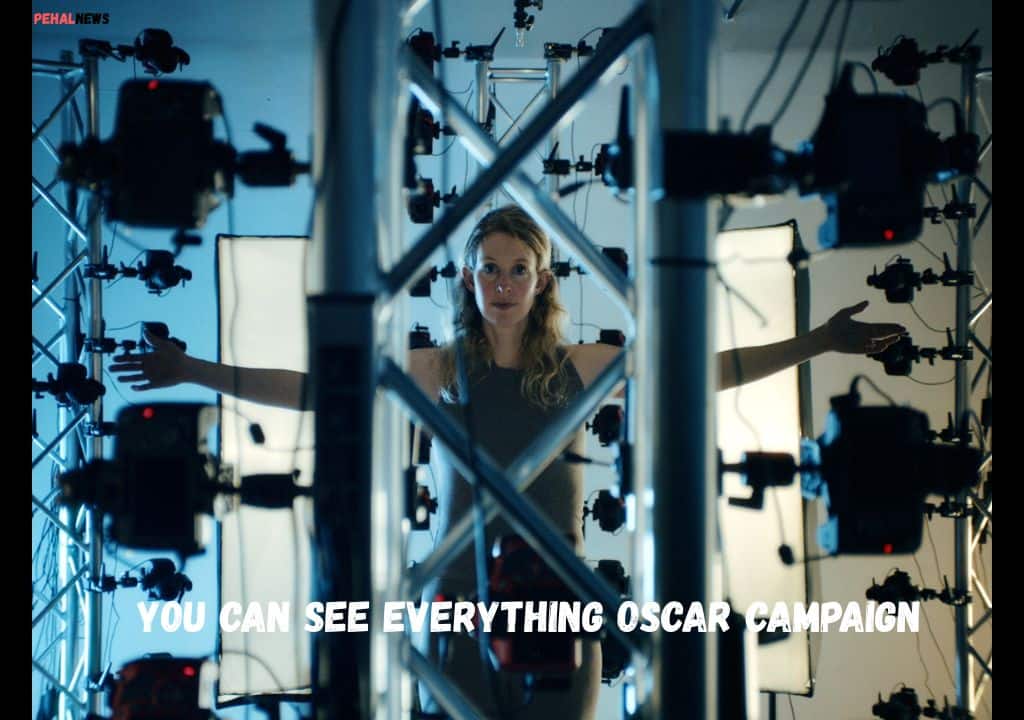
A24 is taking an unconventional approach to awards season with You Can See Everything, the Nathan Fielder and Lance Oppenheim documentary about Elizabeth Holmes. Its box-office success and ambitious Oscar campaign have made it one of the most talked-about films of 2026.
Introduction: You Can See Everything Oscar Campaign Makes Headlines
The You Can See Everything Oscar campaign is drawing attention across Hollywood after the documentary delivered an impressive opening weekend and emerged as a serious topic of discussion during the 2027 Academy Awards race. Distributed by A24 and directed by Nathan Fielder and Lance Oppenheim, the film examines the life of Elizabeth Holmes, the former Theranos chief executive whose rise and criminal conviction became one of Silicon Valley’s most widely discussed business scandals.
Released in theatres on October 16, 2026, You Can See Everything has attracted attention for its unusual storytelling, critical reception and willingness to challenge the conventional boundaries of documentary filmmaking. Its commercial performance has also encouraged discussion about whether a nonfiction film can compete beyond the traditional documentary categories.
According to Variety, A24 is pursuing an ambitious awards strategy that includes Best Picture, Best Supporting Actress and several technical categories. The You Can See Everything Oscar campaign is therefore not simply about winning recognition as a documentary. It is also testing how Academy voters respond to a film that blends observational filmmaking, personal encounters and dramatic reenactments.
Although nominations have not been confirmed, the campaign has already made the film one of the notable talking points of the early awards season.
What Is You Can See Everything About?
At its centre, You Can See Everything follows Holmes during the 34 days before she reported to prison to begin serving her sentence for fraud. Rather than presenting a conventional retrospective account of the Theranos scandal, the filmmakers attempt to observe Holmes in a private setting and explore the complicated relationship between public reputation and personal behaviour.
The official description from A24 explains that Holmes invited a sceptical film crew to document her life shortly before her imprisonment. What begins as an intimate portrait develops into a three-year filmmaking journey.
Holmes founded Theranos in 2003 and promoted technology that she claimed could perform numerous medical tests using only a small amount of blood. The company attracted significant investment and public attention before investigations exposed serious problems with its technology and business practices. Holmes was convicted of fraud-related offences and sentenced to prison.
The documentary does not simply revisit those events. It also examines the difficulty of interpreting what happens when a filmmaker spends time with a person whose public image has already been shaped by years of controversy.
That approach helps explain why the You Can See Everything Oscar campaign has generated discussion across several parts of the film industry.
Official film information: https://a24films.com/films/you-can-see-everything
Why A24 Is Pursuing Best Picture
The Best Picture category is the most ambitious element of the You Can See Everything Oscar campaign. Traditionally, documentaries compete primarily in the Academy Awards’ dedicated documentary categories, while Best Picture is dominated by narrative features.
A campaign seeking recognition in the Academy’s top category therefore faces a significant challenge. Voters must consider not only the film’s subject but also its filmmaking, storytelling, cultural impact and overall cinematic achievement.
The film’s supporters may argue that its unconventional structure makes it comparable to ambitious narrative cinema, even though it is rooted in real people and events. Its combination of observation, performance and self-reflection creates a viewing experience that does not fit neatly into a single genre.
The campaign also benefits from the attention surrounding the film’s theatrical release. Strong audience interest can help a title remain visible during awards season, when studios compete for critics’ attention, industry screenings and voters’ consideration.
However, box-office success does not guarantee an Oscar nomination. Academy members vote through different branches, and films must meet the applicable eligibility and voting requirements. The Best Picture campaign remains an ambition rather than a confirmed result.
The You Can See Everything Oscar campaign will therefore need to convert early enthusiasm into sustained support among Academy voters.
Amanda Seyfried and the Supporting Actress Campaign
One of the most discussed aspects of the awards strategy concerns Amanda Seyfried, whose appearance in the documentary introduces an unusual connection between acting and nonfiction filmmaking.
Seyfried previously portrayed Holmes in the television drama The Dropout. In You Can See Everything, she participates in a later section involving reenactments connected to the filmmakers’ experiences with Holmes.
The decision to campaign for supporting-actress recognition highlights the film’s complicated relationship with traditional genre definitions. Seyfried is not simply appearing in a standard scripted drama. Her role forms part of a documentary that reflects on performance, representation and the challenges of interpreting another person.
The You Can See Everything Oscar campaign could therefore prompt debate about how the Academy should assess acting when a performance appears within a documentary framework.
The campaign does not mean that a nomination is guaranteed. Academy eligibility rules and category decisions remain important, and voters will ultimately determine whether the performance receives sufficient support.
Nevertheless, the possibility has helped bring the film to the attention of people who might not ordinarily follow documentary awards.
Christopher Abbott and Other Potential Categories
The campaign also includes Christopher Abbott, who appears in reenactments as Billy Evans, Holmes’ partner. Reporting on A24’s strategy indicates that the studio is pursuing supporting-actor consideration for Abbott.
Beyond the acting categories, the You Can See Everything Oscar campaign is looking at areas that include Best Director, cinematography, costume design, film editing, makeup and hairstyling, production design, original score and sound.
These categories reflect the breadth of work involved in constructing a film that moves between documentary observation and staged sequences.
Editing is particularly relevant to a story that spans several years and changes its approach as the filmmakers encounter new questions. Cinematography and sound also help establish the atmosphere of the film, while production and costume design become important when scenes are recreated.
The Best Director discussion centres on Fielder and Oppenheim’s collaboration and their decision to build a film around uncertainty rather than a straightforward chronological account.
The campaign’s breadth is notable, but each category has its own eligibility requirements and voting process. The studio’s plans should not be confused with official Academy nominations.
A $15 Million Opening Weekend Raises the Stakes
The film’s commercial performance has become another major part of the story.
According to TheWrap, You Can See Everything earned an estimated $15 million during its opening weekend from 855 locations in North America. The publication reported a per-theatre average of approximately $17,543, an impressive result for a documentary released on a relatively limited number of screens.
The opening helped place the film among the most prominent documentary launches of recent years. It also demonstrated that audiences could be drawn to a complex nonfiction project about a controversial business figure.
For A24, the performance offers a strong starting point for the You Can See Everything Oscar campaign. A successful theatrical release can improve public awareness, encourage further screenings and give awards voters a reason to pay attention.
Still, an opening weekend is only one measure of a film’s performance. Its longer-term results will depend on audience interest, the expansion of its theatrical release and competition from other films arriving during the awards season.
The documentary’s performance also raises a broader question for the industry: can a challenging, nearly three-hour documentary attract a mainstream audience when its subject is already familiar from news reports and previous screen adaptations?
The early numbers suggest substantial interest, although its eventual financial performance remains to be seen.
Box-office coverage: https://www.thewrap.com/creative-content/movies/you-can-see-everything-earns-largest-doc-opening-since-2013/
Why the Film’s Unusual Style Matters
The You Can See Everything Oscar campaign is closely connected to the film’s unusual approach to truth, performance and storytelling.
Traditional documentaries often rely on interviews, archival footage, narration and direct observation. This film begins with an observational approach but develops into a more self-conscious exploration of how filmmakers interpret their subjects.
Nathan Fielder is known for projects that blur the line between reality and performance, including Nathan for You and The Rehearsal. Lance Oppenheim, meanwhile, has established a reputation as a documentary filmmaker interested in unusual characters and carefully constructed cinematic environments.
Their collaboration produces a film in which the process of making the documentary becomes part of the story.
That creates opportunities for discussion about how viewers interpret evidence, how subjects present themselves and how filmmakers shape the material they record. It also raises ethical questions about the relationship between documentary subjects and the people who tell their stories.
These qualities may appeal to voters who value experimentation. Other viewers may prefer a more conventional distinction between factual observation and dramatic reconstruction.
The debate itself has helped the film stand out during awards season.
The Challenges Facing the Oscar Campaign
Despite the excitement surrounding the film, the You Can See Everything Oscar campaign faces several obstacles.
First, documentaries have historically faced a difficult path into Best Picture. Recognition in the documentary category does not automatically translate into support from the broader Academy electorate.
Second, the film’s genre-blending approach may divide audiences. Some viewers may regard its reenactments and self-reflexive structure as innovative, while others may question how those choices affect its factual presentation.
Third, the awards calendar is crowded. Numerous films compete for attention, and studios must maintain visibility throughout months of screenings, publicity and industry events.
Finally, a successful theatrical launch does not establish the outcome of an awards campaign. Commercial results, critical reviews and social-media attention can influence the conversation, but nominations depend on Academy voting.
For these reasons, the film’s awards ambitions should be treated as a developing story rather than a prediction of victory.
What the Campaign Could Mean for Documentary Filmmaking
The significance of the You Can See Everything Oscar campaign extends beyond a single title.
If a documentary earns recognition in major categories outside the documentary branch, it could encourage more filmmakers and distributors to experiment with hybrid forms. The film’s approach demonstrates that nonfiction cinema can incorporate elements of performance, reflection and carefully constructed storytelling without abandoning its engagement with real events.
It may also encourage discussion about how awards bodies define acting and directing when those disciplines operate within a documentary.
However, one campaign would not automatically change Academy rules or eliminate the differences between documentary and narrative filmmaking. Any wider effect would depend on the film’s actual reception, its eligibility and the decisions of Academy voters.
For independent distributors, the film also provides a case study in how an unusual project can attract audiences through strong word of mouth, critical interest and an ambitious release strategy.
What Happens Next?
As the 2027 Academy Awards season progresses, the main question is whether the film’s early momentum can translate into official recognition.
The You Can See Everything Oscar campaign will be judged through the Academy’s eligibility process, category decisions, voting and eventual nominations. The film’s documentary credentials, potential acting recognition and technical achievements will each face different tests.
For audiences, the film is already an example of how documentary filmmaking can move beyond a straightforward retelling of a familiar scandal. For the industry, its campaign presents a test of whether voters are willing to consider a genre-blending nonfiction film across a wider range of categories.
No nomination or award victory should be assumed at this stage. What is clear is that the film has captured considerable attention and created a conversation about the boundaries of documentary cinema.
Conclusion
The You Can See Everything Oscar campaign has quickly become one of the notable awards-season stories of 2026. A24 is seeking recognition for a documentary that combines an intimate look at Elizabeth Holmes with an unconventional approach to performance, observation and filmmaking.
Its reported $15 million opening weekend has strengthened its visibility, while the planned Best Picture, Supporting Actress and technical-category pushes have widened the conversation around its potential.
Yet the campaign still faces substantial challenges. Oscar ambitions are not the same as nominations, and critical enthusiasm does not guarantee votes.
Whether or not the film receives recognition across multiple categories, its campaign has already raised important questions about what documentary filmmaking can achieve and how awards institutions evaluate work that crosses traditional genre boundaries.
For now, You Can See Everything remains a film to watch as the 2027 Oscars race develops.
Frequently Asked Questions
1. What is You Can See Everything about?
It is a documentary directed by Nathan Fielder and Lance Oppenheim that follows Elizabeth Holmes shortly before she began serving her prison sentence and develops into an exploration of filmmaking, performance and perception.
2. Which Oscar categories is the film targeting?
Reporting indicates that A24 is pursuing Best Picture, Best Supporting Actress, Best Documentary Feature and several other categories, including directing and technical awards. These are campaign plans, not confirmed nominations.
3. Why is Amanda Seyfried connected to the campaign?
Seyfried appears in reenactments within the documentary after previously portraying Holmes in The Dropout. A24 is pursuing supporting-actress consideration for her performance.
4. How much did the documentary earn in its opening weekend?
TheWrap reported an estimated $15 million opening weekend from 855 North American locations.
5. Who directed You Can See Everything?
The film was co-directed by Nathan Fielder and Lance Oppenheim.
6. Has You Can See Everything received Oscar nominations?
The campaign announcement does not mean nominations have been confirmed. The film’s status will depend on Academy eligibility, voting and the official nomination announcement.