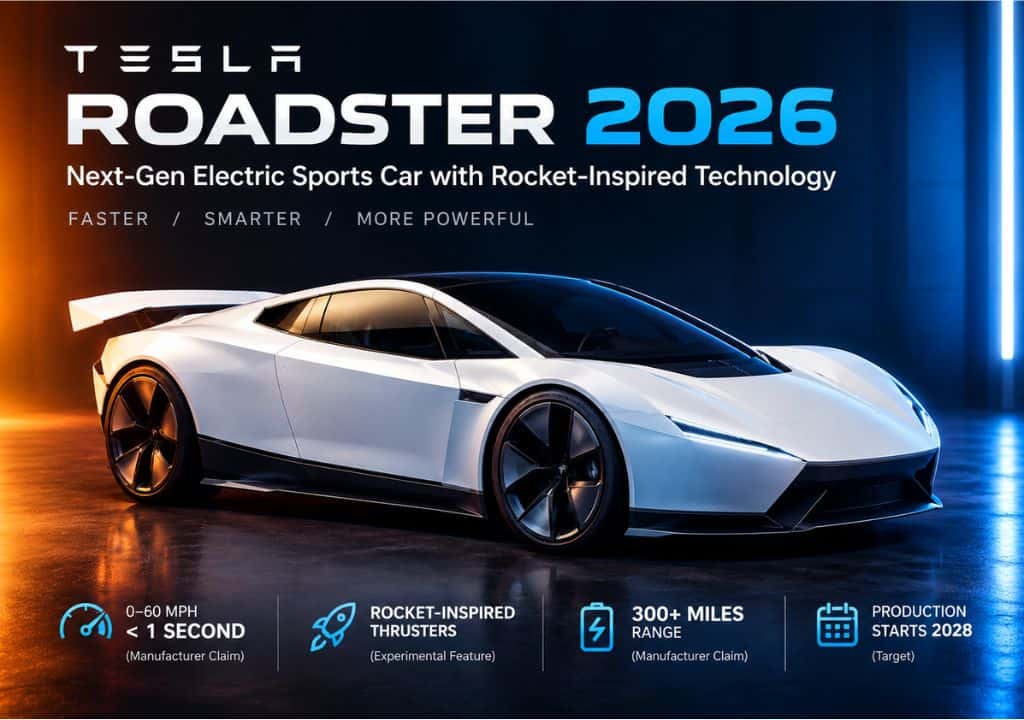
The Tesla Roadster 2026 has attracted international attention after Tesla unveiled its redesigned next-generation electric sports car at a SpaceX facility in Texas on October 15, 2026. The presentation featured dramatic demonstrations involving rocket-style thrusters, rapid acceleration and an experimental system designed to help the vehicle perform unusual manoeuvres.
The unveiling marks a major milestone for a car that has been anticipated for years. Tesla first introduced its next-generation Roadster concept in 2017, originally promising customer deliveries in 2020. Repeated delays left buyers and automotive enthusiasts waiting for a production-ready vehicle.
Now, the Tesla Roadster 2026 has returned to the spotlight with an ambitious combination of electric performance and aerospace-inspired engineering. Tesla says production is planned to begin in 2028, although a firm customer-delivery schedule has not been announced.
The latest demonstration included a version of the car using cold-gas thrusters developed with SpaceX engineering involvement. The system allowed the demonstration vehicle to lift briefly into the air and rotate during controlled manoeuvres. Tesla also highlighted a claimed acceleration time of less than one second from zero to 60 miles per hour.
However, the announcement should not be mistaken for the immediate arrival of a mass-market flying car. The technology demonstrated at the event has not been established as a road-approved feature available to ordinary customers.
The Tesla Roadster 2026 therefore represents both an ambitious engineering project and a test of Tesla’s ability to turn years of promises into a commercial product.
What Makes the New Tesla Roadster Different?
The Tesla Roadster 2026 is being developed as a high-performance electric sports car that showcases Tesla’s engineering capabilities. Its latest presentation places particular emphasis on acceleration, aerodynamic performance and the potential use of SpaceX-inspired technology.
Unlike conventional electric vehicles designed primarily for everyday transport, the Roadster is intended to occupy the high-performance luxury segment. It is expected to appeal to buyers interested in advanced technology, distinctive styling and exceptional driving performance.
The new model also carries symbolic importance for Tesla. A high-profile sports car can demonstrate technological ambitions in a way that an ordinary passenger vehicle cannot, even if its sales volumes remain relatively small.
Tesla’s original Roadster helped introduce the company to a wider automotive audience. Released in 2008, it was Tesla’s first production electric vehicle and helped challenge the assumption that electric cars had to be slow or unexciting.
The Tesla Roadster 2026 seeks to build on that legacy with a more dramatic technological showcase. Yet the challenge is different today: Tesla must demonstrate not only that the vehicle can perform impressive stunts but also that it can be manufactured, certified and delivered to customers.
Rocket Thrusters and the SpaceX Connection
One of the most talked-about elements of the Tesla Roadster 2026 is its experimental rocket-style propulsion system.
During the unveiling, Tesla demonstrated cold-gas thrusters that released pressurised gas to generate thrust. Unlike a conventional rocket engine that burns propellant, a cold-gas thruster produces force by expelling stored gas through a nozzle.
Tesla and SpaceX engineers have worked together on the technology showcased during the demonstration. The system was presented as a way to produce short bursts of thrust, enabling the vehicle to perform manoeuvres that would be impossible for an ordinary road car.
The demonstration also included a suction-based system intended to increase grip by drawing air from beneath the vehicle. Together, the systems created a dramatic presentation involving an inverted ramp and brief aerial movements.
However, important distinctions remain. The demonstration does not establish that every version of the Tesla Roadster 2026 will have flight-capable hardware. Tesla lists different configurations, and the most advanced Rocket version is described as invitation-only.
The company has also not established that the vehicle can operate as a conventional flying car in public traffic. Aviation rules, road-safety requirements and jurisdiction-specific regulations would present substantial obstacles to such use.
For prospective buyers, the key question is which technologies will be included in each production configuration and which features will remain experimental.
Tesla Roadster 2026 Performance Claims
Tesla has made extraordinary performance claims for the new Roadster. At the unveiling, company executives said the vehicle could accelerate from zero to 60 miles per hour in less than one second and achieve a top speed exceeding 230 mph.
The company also described a driving range of more than 300 miles on a single charge.
These figures are manufacturer claims rather than independently verified results from a production vehicle tested under standardised conditions. Actual performance may depend on the final specification, battery configuration, tyres, road conditions and testing methodology.
The acceleration claim is particularly ambitious. Achieving a sub-one-second sprint to 60 mph would require the vehicle to manage immense forces, maintain traction and deliver substantial power. Independent testing will be necessary to establish how the production car performs in repeatable real-world conditions.
The Tesla Roadster 2026 is also expected to use advanced aerodynamic systems and lightweight materials to improve performance. However, final production specifications and the extent to which the demonstrated technologies will be available to customers remain important unanswered questions.
Until independent tests become available, buyers should treat the advertised figures as targets or claims, not guaranteed everyday results.
Tesla Roadster 2026 Price and Reservation Deposits
Tesla has not announced a confirmed final purchase price for the new Roadster at the October 15 unveiling. The reservation amounts published by Tesla should not be confused with the total price of the finished vehicle.
Reuters reported that Tesla’s US reservation page listed a Performance configuration requiring a $50,000 deposit. A Thrust configuration, associated with additional acceleration technology, listed a $250,000 deposit. The Rocket configuration, which includes the experimental flight system, was described as invitation-only.
These amounts represent reservation commitments, not final retail prices. Buyers should review the current official terms carefully, including cancellation conditions, payment deadlines and any restrictions attached to a particular configuration.
The original next-generation Roadster concept was presented in 2017 with a proposed starting price of around $200,000. That historic figure should not be treated as a confirmed price for the redesigned model in 2026.
The final cost of the Tesla Roadster 2026 could vary by market, equipment, taxes, import duties and regulatory requirements. Until Tesla publishes definitive prices, it is not possible to calculate a reliable final on-road cost for every country.
Tesla Roadster 2026 Launch Date: Why Production Is Still Years Away
Despite the unveiling, the Tesla Roadster 2026 is not yet a widely available production car.
Tesla has targeted 2028 for the start of production. That target follows years of delays since the original concept was revealed in 2017.
The gap between a public demonstration and a customer-ready vehicle can be significant. Manufacturers must finalise engineering, validate performance, establish production processes and meet safety requirements before delivering vehicles at scale.
The Roadster’s experimental systems add further complexity. The cold-gas thrusters and suction technology demonstrated at the event will need to be evaluated for reliability, safety, maintainability and compatibility with the relevant vehicle configuration.
Regulatory approval is especially important for any version that incorporates flight-capable hardware. A system suitable for a controlled demonstration does not automatically qualify for use on public roads.
The Tesla Roadster 2026 may therefore remain a development project for some time even as reservations attract interest. Customers should distinguish Tesla’s stated production target from a guaranteed delivery date.
The company’s history of revising Roadster deadlines also means that future updates will be important when assessing whether the 2028 target remains realistic.
Will the New Tesla Roadster Launch in India?
Interest in the Tesla Roadster 2026 is not limited to the United States. Indian electric-vehicle enthusiasts have also been following developments surrounding Tesla’s high-performance sports car.
An October 17 report by The Economic Times said Tesla had opened Roadster reservations in India. However, a reservation announcement does not necessarily establish a confirmed Indian delivery date, final vehicle price or full regulatory approval for every configuration.
India’s final cost could be significantly affected by import duties, taxes, shipping expenses and the specifications offered in the market. A US reservation deposit cannot be converted directly into an Indian on-road price.
The Rocket version would raise additional questions because its experimental flight system is not approved for ordinary public-road use. The more conventional Roadster configurations would also need to meet applicable Indian vehicle requirements before customer deliveries.
Anyone considering a reservation for the Tesla Roadster 2026 in India should consult Tesla’s official local website for current terms and confirm the exact model, deposit conditions and cancellation policy before making a payment.
For now, the most important details to watch are official Indian pricing, delivery timing and which versions Tesla intends to offer locally.
Why the Roadster Matters to Tesla
The Tesla Roadster 2026 arrives at a time when the company is expanding its focus beyond traditional electric vehicles into autonomous driving, robotaxis and robotics.
That makes the Roadster important as a technology showcase, even if it does not become a high-volume product. A limited-production sports car can reinforce a manufacturer’s engineering image and attract attention to its wider technology ecosystem.
Reuters reported that Tesla’s shares rose in premarket trading after the unveiling, although short-term share-price movements do not prove that the vehicle will be commercially successful.
The Roadster may also strengthen the public association between Tesla and SpaceX. Both companies are led by Elon Musk, and the demonstration highlighted the possibility of applying aerospace engineering concepts to automotive products.
Still, the financial contribution of the Tesla Roadster 2026 is uncertain. High-performance sports cars generally appeal to a smaller customer group than mainstream electric sedans and SUVs. Production costs, delivery volumes and the ability to fulfil reservations will determine the project’s commercial significance.
For investors, the Roadster’s launch is one development among many, rather than a substitute for examining Tesla’s overall financial performance and manufacturing results.
What Buyers Should Check Before Reserving
Potential buyers should approach the Tesla Roadster 2026 with interest but also carefully assess the terms.
First, confirm whether the reservation is for the Performance, Thrust or Rocket configuration. These versions should not be assumed to share identical capabilities.
Second, check the deposit terms. A large reservation payment is not the same as a final purchase price, and customers should understand whether payments are refundable and what deadlines apply.
Third, review the production timeline. Tesla has targeted 2028, but a production target is not a guaranteed delivery date.
Fourth, distinguish manufacturer performance claims from independently tested results. Standardised testing will be needed to confirm acceleration, top speed, range and repeatability.
Finally, check local regulations. Road legality and any permission required for experimental flight systems may differ across countries and even between jurisdictions within a country.
These checks are particularly important for buyers considering an expensive early reservation for the Tesla Roadster 2026 before final production specifications are available.
Conclusion
The Tesla Roadster 2026 is one of Tesla’s most ambitious vehicle projects, combining electric sports-car performance with experimental technology developed alongside SpaceX engineers. Its unveiling on October 15, 2026, has renewed attention on a model that has been delayed for years.
The vehicle’s headline claims include acceleration from zero to 60 mph in less than one second, a top speed above 230 mph and a driving range exceeding 300 miles. Tesla has also demonstrated cold-gas thrusters and suction technology capable of producing extraordinary manoeuvres under controlled conditions.
However, major questions remain. Final retail pricing has not been confirmed, production is targeted for 2028, and the most advanced Rocket configuration is not approved for ordinary public-road use. Independent performance testing and local regulatory decisions will be essential to understanding what customers will actually receive.
For Indian buyers, reports of reservation availability should be followed by confirmation of local pricing, model specifications and delivery terms.
Ultimately, the Tesla Roadster 2026 is a striking engineering statement, but its long-term success will depend on whether Tesla can deliver a safe, reliable and production-ready vehicle that matches the promises made during its unveiling.