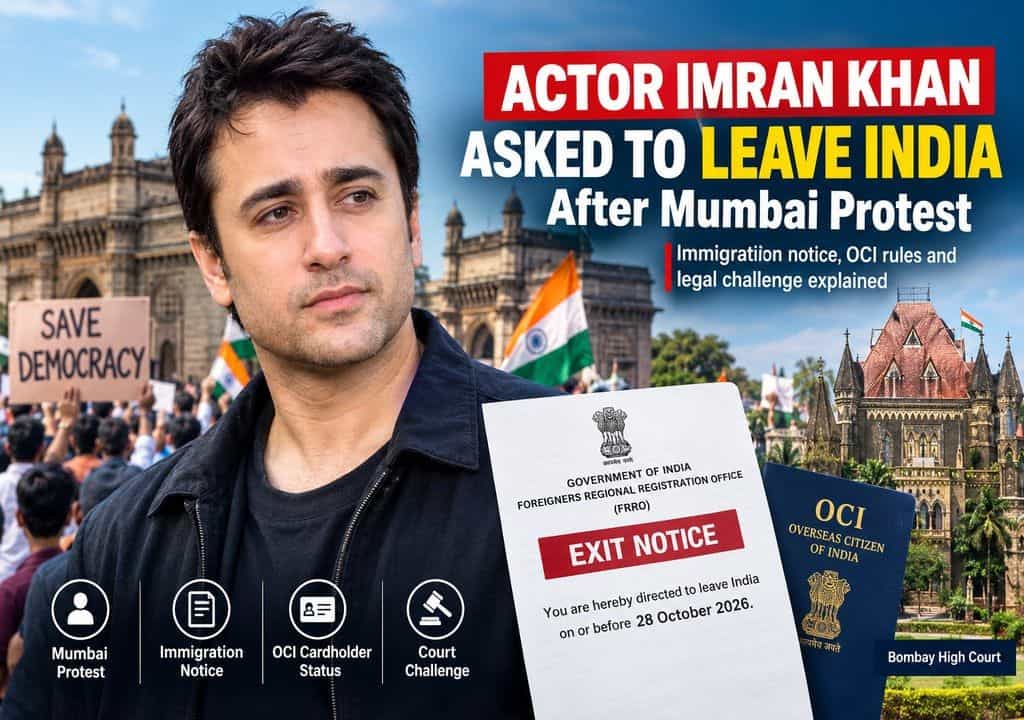
The news that Imran Khan asked to leave India has drawn attention across Bollywood and the wider political landscape after the actor received a notice from the Foreigners Regional Registration Office (FRRO). The notice reportedly directs him to leave the country by October 28, 2026, following his participation in a protest in Mumbai against Chief Election Commissioner Gyanesh Kumar.
The development has raised questions about the rights and responsibilities of Overseas Citizen of India (OCI) cardholders, the authority of immigration officials, and the boundaries of political participation by foreign nationals in India.
Imran Khan, known for films including Jaane Tu… Ya Jaane Na and I Hate Luv Storys, is a US citizen and holds an OCI card. The notice reportedly alleges that his participation in the demonstration violated rules governing foreign nationals in India.
Khan is preparing to challenge the notice through legal proceedings in the Bombay High Court. His legal team has disputed the action and questioned whether the notice clearly identifies the provisions he allegedly violated.
What Happened at the Mumbai Protest?
The controversy began on October 10, 2026, when a protest took place at August Kranti Maidan in Mumbai. Demonstrators called for the resignation of Chief Election Commissioner Gyanesh Kumar.
Imran Khan was among the people detained by Mumbai Police during the demonstration. He was subsequently released, according to media reports.
After the protest, a complaint was reportedly filed by BJP leader Kirit Somaiya, who questioned the participation of a foreign citizen in a political demonstration. The complaint was forwarded to the relevant authorities, and the FRRO subsequently issued the notice directing Khan to leave India.
According to reporting by The Indian Express, the notice followed allegations that Khan had breached rules applicable to foreign nationals and OCI cardholders. Somaiya also made broader claims about foreign involvement in protests, but those claims should be understood as allegations rather than established facts.
The sequence of events has made Imran Khan asked to leave India a widely discussed entertainment and legal news story. However, the existence of a notice does not by itself establish that the actor committed an offence. That question may depend on the legal provisions invoked, the conditions applicable to his immigration status, and the arguments presented before the court.
Why Was Imran Khan Given a Leave India Notice?
The reported reason for the notice is Khan’s participation in the October 10 protest. The FRRO action is linked in media reports to the Immigration and Foreigners Act, 2025, which governs important aspects of the entry, stay and removal of foreign nationals in India.
Under the law, authorities have powers to regulate the presence of foreign nationals and may order removal in circumstances specified by legislation and applicable rules. The government’s authority over foreign nationals is not identical to its authority over Indian citizens.
However, the precise legal grounds in Khan’s individual case have been questioned by his lawyers. Hindustan Times reported that his legal team said the notice did not explicitly identify the provisions they believed he had violated.
This distinction is important. The government’s general powers under immigration law and the legality of a particular notice are separate issues. Whether the action is legally justified in this case may be examined through the documents, applicable law and arguments presented in court.
The case involving Imran Khan asked to leave India should therefore not be described as a final deportation decision or proof of wrongdoing. At this stage, the reporting concerns a notice directing him to leave and his intention to challenge that directive.
Who Is Imran Khan, and What Is His Citizenship Status?
Imran Khan is an actor associated with Hindi-language cinema. He became widely known after starring in Jaane Tu… Ya Jaane Na and later appeared in films such as I Hate Luv Storys and Delhi Belly.
Khan is a US citizen and holds an Overseas Citizen of India card. OCI status provides eligible foreign citizens of Indian origin with several privileges, including long-term access to India under the applicable scheme. It does not, however, confer Indian citizenship.
OCI cardholders do not have the same political rights as Indian citizens. For example, OCI status does not grant the right to vote in Indian elections or contest them. The extent to which other political activities are permitted depends on the relevant laws, regulations and conditions.
The distinction between citizenship and OCI status is central to the controversy. Supporters of Khan have questioned whether participation in the protest was sufficient grounds for the notice, while authorities are entitled to apply the legal framework governing foreign nationals.
The question of Imran Khan asked to leave India is consequently about more than the actor’s celebrity status. It also concerns how immigration rules are interpreted and applied when a foreign national participates in a public demonstration.
What Does Indian Law Say About OCI Cardholders and Protests?
The legal position is more complicated than a simple claim that every foreign national is automatically prohibited from attending a protest.
The Immigration and Foreigners Act, 2025, provides a framework for regulating foreign nationals in India. The government has powers under the law to address specified violations and, in certain circumstances, direct a foreign national to leave the country.
At the same time, The Indian Express reported that the legislation does not contain an express provision simply stating that all foreign nationals or OCI cardholders are prohibited from attending every public protest. The legal assessment may depend on the specific rules, conditions and grounds relied upon by authorities.
India’s constitutional guarantees of freedom of speech and peaceful assembly are framed as rights of citizens. Foreign nationals do not automatically enjoy every constitutional right on the same terms as Indian citizens. That distinction, however, does not eliminate the need to apply immigration law correctly.
In Khan’s case, his lawyers have reportedly disputed the allegation that his conduct violated applicable conditions. They have also questioned the clarity of the notice. The authorities’ legal position and the actor’s challenge must be assessed through the relevant documents and any judicial proceedings.
For that reason, reports that Imran Khan asked to leave India should not be taken as a definitive statement that the law categorically prohibits all foreign nationals from attending any demonstration. The specific legal basis and facts of this case matter.
Imran Khan Plans to Challenge the Notice in the Bombay High Court
Khan’s legal team has said it intends to challenge the FRRO notice before the Bombay High Court. Reports published on October 15 indicated that the lawyers were preparing a petition and seeking an urgent hearing.
The legal challenge is significant because it could bring the grounds for the notice under judicial scrutiny. Khan’s lawyers have argued that he did not violate the applicable conditions and have questioned the notice’s failure, as they describe it, to clearly specify the provisions allegedly contravened.
The court may consider the relevant statutory framework, the wording of the notice, the circumstances of the protest and the submissions made by both sides. The outcome cannot be predicted from the notice alone.
As of October 16, the latest reporting reviewed for this article indicates that a legal challenge is being pursued. Readers should check for subsequent court updates before treating any development as a final decision.
The legal proceedings will be especially important in determining what happens next after Imran Khan asked to leave India became a major news headline. A court challenge can contest an administrative action, but filing a petition does not automatically mean the notice has been cancelled or that the actor has won the case.
Political Reactions and Public Debate
The notice has prompted debate among political figures, commentators and people following Bollywood news. Somaiya, whose complaint reportedly preceded the FRRO action, has argued that foreign nationals should not participate in political activities in India. His claims about the broader purpose of protests are allegations and should not be treated as independently verified evidence.
The episode has also raised wider questions about the treatment of OCI cardholders and the distinction between their residency privileges and the political rights of citizens.
Some observers may view immigration enforcement as a matter of compliance with the law. Others may question whether a notice directing a long-term resident to leave the country is proportionate in the circumstances. Those competing arguments do not resolve the legal issue, which depends on the applicable provisions and the evidence.
The case has attracted attention partly because Khan is a known actor and partly because it involves a politically sensitive demonstration. Nevertheless, the same legal principles should be examined regardless of the individual’s fame.
The public discussion surrounding Imran Khan asked to leave India should distinguish between verified developments, statements made by the parties, and speculation about the eventual outcome.
What Happens Next?
The immediate next step is the legal process surrounding the notice. Khan’s lawyers are seeking to challenge the directive, while the October 28 deadline remains an important date reported by the media unless it is changed or affected by a court order or other official action.
Readers should look for reliable updates confirming whether the petition has been filed, whether the Bombay High Court has issued directions, and whether the authorities have provided further details about the legal grounds for the notice.
Several questions remain open: What specific provisions are relied upon? How will the court interpret the rules applicable to OCI cardholders? Will any interim relief be granted? And will the authorities clarify their position in response to the challenge?
Until those questions are answered, it would be premature to conclude that Khan must inevitably leave India or that the notice has already been overturned.
Conclusion
The notice directing Imran Khan to leave India by October 28, 2026, after he attended a Mumbai protest has become a significant story involving Bollywood, immigration law and political participation. The actor is a US citizen and OCI cardholder, and his lawyers are challenging the FRRO action.
The central issue is whether the notice is legally justified under the rules governing foreign nationals and OCI status. The authorities’ powers, the precise grounds for the notice and the arguments raised by Khan’s legal team will all be relevant to the outcome.
For now, Imran Khan asked to leave India describes an ongoing legal dispute, not a final court judgment. The situation should be followed through reliable updates, with a clear distinction between allegations and established findings.