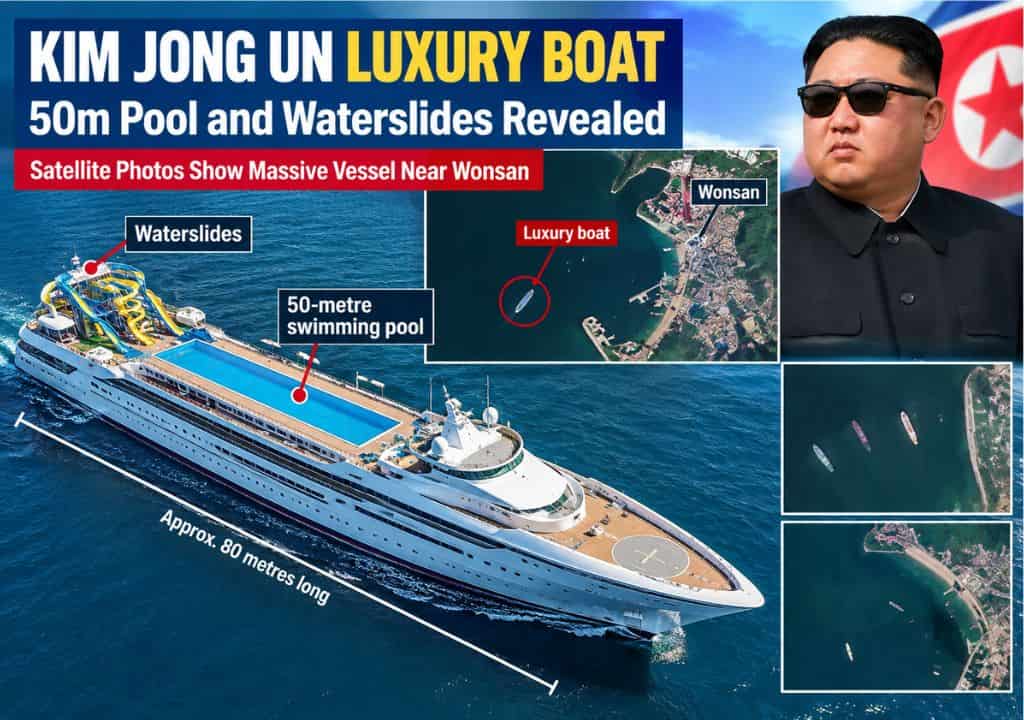
A striking discovery in satellite imagery has drawn international attention to the lifestyle of North Korean leader Kim Jong Un. An approximately 80-metre-long vessel, featuring a swimming pool estimated to be 50 metres long and a collection of waterslides, has repeatedly appeared near North Korea’s eastern coastline, close to a seaside retreat associated with the country’s leadership.
The Kim Jong Un luxury boat story emerged after BBC journalists analysed satellite imagery supplied by Vantor. The images showed the large vessel near the Wonsan coast between July and mid-October 2026. Its unusual recreational features make it stand out from conventional boats visible in the area.
According to the BBC report published on October 17, the vessel had spent months at a maintenance facility before moving in early July to waters off the Kalma Peninsula. The area is close to Wonsan, where Kim Jong Un and his family are associated with a large seaside villa.
The Kim Jong Un luxury boat report also identified three other large vessels in the same coastal region. Those boats were estimated to measure approximately 50, 55 and 60 metres in length.
The images provide a rare glimpse into an area of North Korea that is difficult for independent journalists to observe directly. However, there is an important distinction between seeing a vessel near a leadership retreat and proving who owns it or who was aboard. The satellite imagery supports the reported location and physical characteristics, while the vessel’s precise ownership and occupancy have not been publicly established.
What Do the Satellite Images Show?
The most eye-catching feature of the Kim Jong Un luxury boat is its unusually long swimming pool. At approximately 50 metres, the pool occupies a substantial portion of the vessel’s deck. A group of waterslides at one end adds to the ship’s recreational design.
At an estimated 80 metres long, the vessel measures around 263 feet from bow to stern. Its size and distinctive deck arrangement make it relatively easy for analysts to recognise in successive satellite images.
The BBC’s analysis followed the vessel across several months. It had reportedly remained at a maintenance facility for an extended period before appearing off the Kalma Peninsula in early July. Further imagery showed it in the coastal waters during the months that followed.
These observations are significant because North Korea is one of the world’s most closed societies. Foreign journalists have limited access to many locations, and information about the private activities of the country’s leadership can be difficult to verify.
Satellite imagery offers a way to monitor physical changes without requiring direct access. Researchers can compare photographs taken on different dates, identify vessels by their dimensions and distinctive features, and establish whether ships have moved between locations.
Nevertheless, the Kim Jong Un luxury boat images have limitations. A satellite photograph can show a boat’s approximate location and visible layout, but it generally cannot identify every passenger or confirm the purpose of a particular journey.
The images should therefore be understood as evidence of maritime activity near Wonsan, not as proof that Kim personally travelled aboard the vessel on any specific date.
Four Large Vessels Seen Around Wonsan
The 80-metre vessel was not the only large boat highlighted in the investigation. The BBC reported tracking four vessels around the Wonsan area, with estimated lengths of 50, 55, 60 and 80 metres.
Their repeated appearance near a coastal property associated with Kim Jong Un has prompted questions about the use of the boats and the people who have access to them.
The largest Kim Jong Un luxury boat attracted the most attention because its pool and waterslides are distinctive features. The other vessels were also reportedly seen around nearby islands and coastal waters during parts of the summer.
The BBC’s reporting drew on satellite imagery, expert analysis and interviews with people familiar with North Korea. Former officials and defectors have described access to vessels of this scale as something likely to be restricted to the country’s top leadership or people connected to it.
That assessment provides context for the images, but it is not the same as documentary proof of ownership. North Korea does not provide the kind of transparent public records that would make it easy to verify the ownership structure of every state-linked or privately used vessel.
The Kim Jong Un luxury boat story consequently rests on a combination of direct visual evidence and informed analysis. The imagery shows the vessels; the broader political context helps explain why researchers believe they may be associated with the ruling family.
Why Is Wonsan Important to Kim Jong Un?
Wonsan is a coastal city on North Korea’s eastern side. Its seaside setting, surrounding islands and recreational facilities have made it an important location for the country’s leadership.
The area has long been associated with the Kim family. Historical reporting and satellite imagery have connected the coastline with recreational properties and vessels used by members of the ruling elite.
The Kim Jong Un luxury boat report notes that a large vessel with similar distinctive characteristics was visible in historical imagery from Wonsan in 2002, when Kim Jong Un’s father, Kim Jong Il, led the country.
That historical comparison suggests the use of large recreational vessels in the area predates Kim Jong Un’s leadership. It does not, on its own, establish that the vessel seen in the latest imagery is the same boat or that ownership has remained unchanged.
Wonsan has also been the focus of North Korea’s efforts to develop coastal tourism. The nearby Kalma coastal resort has been promoted as a leisure destination, with accommodation and other facilities intended to attract visitors.
The contrast between state-promoted tourism and the restricted movement experienced by ordinary citizens has been a recurring subject in reporting about the country.
The Kim Jong Un luxury boat images add another dimension to that picture by showing how large recreational vessels remain part of the coastal landscape around a location linked to the leadership.
What Do the Pool and Waterslides Tell Us?
A 50-metre pool and several waterslides are unusual features for a vessel of this size. They suggest that the boat has been equipped for leisure rather than being designed solely for ordinary transportation.
The pool’s estimated length is particularly notable. Fifty metres is the standard length of an Olympic-size swimming pool, although the presence of a pool of similar length on a boat does not mean the vessel is intended for sporting competition.
The waterslides provide further evidence of the vessel’s recreational character. Together, the features give the Kim Jong Un luxury boat its unusual profile in the satellite images.
However, satellite photographs cannot reveal the full interior layout, the number of people who use the vessel, its operating costs or the details of its onboard amenities. Without independently verified specifications, estimates about the boat’s price or exact equipment would be speculative.
It is also important not to confuse visual estimates with official technical information. The dimensions reported by journalists are based on satellite-image analysis, rather than a publicly released ship specification sheet.
The most defensible conclusion is that the vessel is large, has a conspicuous pool-and-waterslide arrangement, and has been repeatedly observed near Wonsan.
The Contrast With Everyday Life in North Korea
The Kim Jong Un luxury boat story has also renewed discussion about economic inequality and living conditions in North Korea.
The country has faced longstanding problems involving food security, economic isolation and restrictions on personal freedoms. International organisations have documented serious human-rights concerns, including extensive state control over many aspects of public and private life.
A United Nations human-rights assessment published in 2025 described widespread and systematic abuses in North Korea. Reports have also highlighted chronic food insecurity, with an estimated 40% of the population undernourished in the assessment cited by recent coverage.
Those broader conditions form the backdrop to news about luxury assets associated with the country’s leadership. A vessel equipped with a pool and waterslides presents a stark visual contrast to the hardship reported in many communities.
Still, the imagery alone does not explain the full economic circumstances of North Korea or establish how the vessel was financed. The price of this particular boat has not been publicly confirmed in the reporting discussed here.
Comparisons with luxury yachts elsewhere can provide a broad sense of scale, but estimates should not be presented as the confirmed value of this vessel.
The Kim Jong Un luxury boat story is therefore best viewed as one piece of a wider discussion about privilege, restricted access to resources and the gap between the leadership’s reported lifestyle and the circumstances of many citizens.
How Satellite Imagery Helps Report on North Korea
Commercial satellite imagery has become an important tool for journalists and researchers investigating North Korea.
Because access to military, government and leadership-linked locations is tightly restricted, researchers often have to rely on remote observation, official statements, expert interviews and information from people who have left the country.
Satellite images can help answer specific questions. Researchers may identify new construction, track vessels between ports, compare the condition of facilities over time or look for changes in activity around sensitive sites.
In the Kim Jong Un luxury boat investigation, repeated images were particularly useful. Instead of relying on a single photograph, analysts compared observations across several months to follow the vessel’s movement from a maintenance facility to waters near the Kalma Peninsula.
This method can strengthen a report because it provides a sequence of observations rather than one isolated image. It can also help journalists distinguish a temporary appearance from a recurring pattern.
Yet satellite analysis is not infallible. Images may be affected by resolution, weather, viewing angle and the difficulty of distinguishing similar vessels. Analysts must also avoid assuming that proximity proves ownership or that a vessel’s presence proves a particular person is aboard.
The Kim Jong Un luxury boat report illustrates both the value and the limits of this approach: satellite imagery can reveal details that are otherwise difficult to see, while important questions may remain unanswered.
What Remains Unknown About the Vessel?
Despite the attention generated by the photographs, several questions remain unresolved.
First, the vessel’s precise legal owner has not been publicly confirmed. The reported association with Kim Jong Un and his family is based on location, expert assessments, historical context and sources familiar with North Korea.
Second, there is no public confirmation that Kim was personally aboard the boat during the satellite observations. A vessel near a retreat does not necessarily mean its most prominent associated figure is present.
Third, the vessel’s cost, registration details, operating arrangements and full specifications have not been established in the reporting cited here.
Finally, the purpose of each movement cannot be determined from location data alone. The boat may have been used for recreation, maintenance, transport or other activities, but each possibility would require further evidence.
These limitations do not erase the significance of the Kim Jong Un luxury boat discovery. They simply define what the available evidence can and cannot prove.
Further satellite images, credible reporting or official documentation could provide additional information over time.
Frequently Asked Questions
What is the Kim Jong Un luxury boat?
The term refers to an approximately 80-metre-long vessel repeatedly seen in satellite imagery near North Korea’s Wonsan coast. It reportedly features a swimming pool around 50 metres long and a cluster of waterslides.
Where was the boat spotted?
The vessel was observed near the Kalma Peninsula, close to Wonsan on North Korea’s eastern coast. The area is associated with a seaside retreat used by Kim Jong Un and his family.
Who owns the vessel?
Its exact ownership has not been publicly confirmed. The BBC’s analysis and sources familiar with North Korea suggest an association with the country’s leadership, but the imagery alone cannot prove legal ownership.
Was Kim Jong Un aboard the boat?
The satellite images do not confirm whether Kim Jong Un was aboard at any particular time. They show the vessel’s location, not the identities of its passengers.
How long is the swimming pool?
The pool is estimated to be approximately 50 metres long, making it one of the most distinctive features visible in the satellite imagery.
Were other boats seen near Wonsan?
Yes. The BBC reported tracking three other large vessels, estimated at approximately 50, 55 and 60 metres, in the same coastal region.
Why is the discovery attracting attention?
The images offer a rare glimpse into the recreational assets associated with North Korea’s leadership. They have also prompted discussion about the contrast between elite lifestyles and the food insecurity and restrictions experienced by many ordinary citizens.
Conclusion
The Kim Jong Un luxury boat story offers a rare look at a large recreational vessel repeatedly observed near North Korea’s Wonsan coast. Satellite images analysed by the BBC show an approximately 80-metre-long boat with a 50-metre swimming pool and waterslides, alongside evidence of several other large vessels in the area.
The vessel’s proximity to a seaside retreat associated with Kim Jong Un and his family has led analysts to believe it may be used by the ruling elite. However, its exact ownership and whether Kim was aboard remain unconfirmed.
The discovery demonstrates how commercial satellite imagery can help journalists investigate activity in one of the world’s most secretive countries. It also highlights the contrast between the luxury associated with the leadership and the economic and human-rights challenges facing many North Koreans.
For now, the Kim Jong Un luxury boat remains a compelling subject of satellite-based reporting, with its location and visible features documented more clearly than its ownership or use.