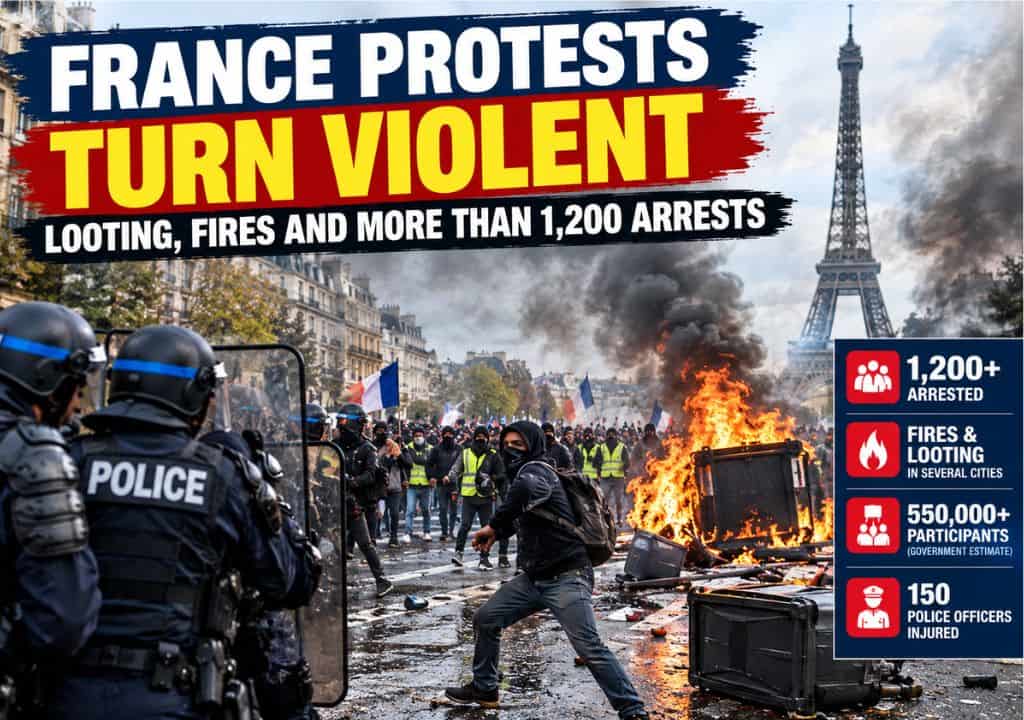
France protests escalated into a major day of unrest, with clashes between demonstrators and police, fires, looting and damage to public buildings reported in several cities. The demonstrations reflected growing anger over living costs, public services and concerns about conditions in schools.
Prime Minister Sébastien Lecornu reported approximately 1,200 arrests as the unrest spread. Interior Minister Laurent Nuñez said around 550,000 people had participated in demonstrations nationwide, while the CGT trade union estimated turnout at approximately 800,000.
Arrest figures changed as reports were updated throughout the day. Earlier coverage cited lower totals, while later statements reported the higher figure. The figures should therefore be attributed to their sources and understood in the context of a developing situation.
The France protests were not uniformly violent. Many people participated in peaceful marches to express concerns about household expenses, education, wages and government priorities. However, violent incidents in particular locations included confrontations with police, fires and attacks on property.
Paris, Limoges, Lyon and Marseille were among the cities affected by serious incidents. Images of smoke, damaged shops and burning buildings drew international attention.
The unrest has renewed debate about the causes of public anger, the government’s response and how authorities can protect peaceful demonstrations while preventing violence.
Why Did France Protests Turn Violent?
France protests grew from several connected grievances rather than a single issue.
Rising prices have placed pressure on household budgets. Demonstrators have raised concerns about food, fuel, energy and other essential expenses, particularly for households whose incomes have not kept pace with the cost of living.
Public services have also become a major source of frustration. Protesters criticised school conditions, teacher shortages and inadequate facilities, arguing that public institutions need more effective support.
Student demonstrations in the preceding weeks helped broaden the movement. Trade unions and other groups joined calls for action, bringing together people with different concerns about economic security and government policy.
Some participants drew comparisons with the Yellow Vest movement, which began in 2018 amid anger about fuel prices, taxation and economic inequality. Although there are similarities, the movements have different participants and political circumstances.
During the France protests, most demonstrators should not be presumed to have participated in violence. Government officials attributed the worst incidents to smaller groups that attacked property, looted shops or confronted police.
This distinction matters. The presence of violence at a demonstration does not mean that everyone attending supported or participated in criminal activity.
Paris: Clashes, Fires and Looting
Paris became one of the principal centres of unrest during the France protests.
Masked groups confronted police and threw projectiles in some areas. Officers deployed tear gas and water cannon as they attempted to disperse violent groups and protect nearby streets and buildings.
Cars, bicycles, rubbish bins and other objects were reportedly set alight. Some shops were looted, while other businesses secured their premises to reduce the risk of damage. Several metro stations were closed at police request because of security concerns.
The incidents disrupted transport and daily life, affecting residents, workers and visitors who were not involved in the demonstrations.
Authorities condemned the destruction and called for those responsible for criminal acts to be identified. The police response also attracted scrutiny, particularly concerning crowd-control tactics and injuries suffered during the demonstrations.
The France protests highlighted the difficult task facing police during large public gatherings: protecting the right to peaceful protest while responding to assaults, arson and looting.
Paris has experienced major demonstrations before, including the Yellow Vest movement. Nevertheless, each episode has its own causes and circumstances, and historical comparisons should not obscure the grievances being raised now.
Limoges: Historic Town Hall Damaged by Fire
One of the most serious incidents occurred in Limoges, where a fire severely damaged the historic town hall.
Reports described extensive damage, including a fire affecting the roof. The incident attracted attention because the building is a prominent part of the city’s civic identity and municipal administration.
Damage to a public building can have consequences beyond the immediate cost of repairs. Town halls provide administrative services and support local government operations. Major repairs can disrupt those services and divert public funds from other priorities.
Authorities condemned the incident, while investigators faced the task of establishing how the fire began and identifying anyone responsible. Conclusions about individual suspects should depend on evidence gathered through a proper investigation.
The fire became one of the most widely reported examples of property damage associated with the France protests.
It also intensified debate over how people responsible for deliberate destruction should be held accountable. Any legal response must establish responsibility, assess the damage and follow the applicable law.
Lyon and Marseille Also Report Incidents
The unrest extended beyond Paris, with serious incidents reported in Lyon and Marseille.
In Lyon, a fire broke out at a tourist office during the demonstrations. The incident raised concerns about the safety of public-facing buildings and businesses during large gatherings.
Marseille also experienced disorder. Reports described damage to shops and municipal facilities, while protesters briefly entered the city hall lobby.
The incidents showed that the unrest was not confined to the capital. Each city experienced different circumstances, and the details of individual incidents need to be established separately.
When violent groups emerge during demonstrations, the effects can extend to residents and businesses that have no involvement in the protests. Damaged facilities, disrupted transport and temporary closures can affect local communities long after crowds have dispersed.
The France protests therefore created challenges for municipal authorities, who must restore services, assess damage and support investigations while responding to the public concerns that brought demonstrators into the streets.
How Did the French Government Respond?
Prime Minister Sébastien Lecornu condemned the violence and said that political demands could not justify attacks on public institutions or private property.
President Emmanuel Macron also pledged that people responsible for violence and destruction would face prosecution. Government officials stressed that peaceful demonstrations and criminal acts should be treated differently.
Interior Minister Laurent Nuñez blamed radical groups and people who exploited the demonstrations to loot businesses for some of the worst incidents. This was the government’s characterisation of the violence and should be attributed as such, rather than treated as proof that all protesters belonged to those groups.
The government faced pressure to restore public order, protect police officers and prevent further damage. At the same time, injuries to demonstrators prompted questions about the use of police equipment.
The France protests response therefore raised two separate questions: how to hold people accountable for attacks on people and property, and how to ensure that police operations comply with legal requirements.
Independent investigations and court proceedings will be important in establishing what happened in individual cases.
Police Injuries and Crowd-Control Concerns
Police officers were among those injured during the unrest. Reuters reported that at least 150 officers had been hurt, citing figures released during the demonstrations.
There were also concerns about injuries to protesters. Reports described a young person suffering a serious hand injury involving a stun grenade. The use of a type of stun grenade against young demonstrators was reportedly suspended while the circumstances came under scrutiny.
These incidents have renewed debate about crowd-control equipment and the risks associated with its use.
Police have a responsibility to protect the public and respond to violence. However, crowd-control tactics can also cause serious injuries, and their legality depends on the circumstances, the equipment involved and the applicable rules.
During the France protests, calls for accountability concerned both violence against police and allegations about police conduct. Independent investigations can help determine what happened and whether individuals or institutions should be held responsible.
It would be premature to assume that every injury proves misconduct or that every police intervention was justified. Both conclusions require evidence.
What Do the Arrest Figures Mean?
The reported arrest total became one of the main headlines surrounding the France protests.
Earlier reports cited hundreds of arrests, including approximately 400 in initial coverage. Later reporting said Lecornu had put the total at around 1,200.
Changing totals are common during fast-moving public-order incidents, as police operations continue and authorities issue updated figures.
An arrest is not the same as a criminal charge, and a charge is not the same as a conviction. Some people may be detained for questioning and released, while others may face further proceedings depending on the evidence.
The reported figure should not be used to suggest that everyone arrested participated in arson, looting or assaults. Individual cases must be assessed separately.
Further information from prosecutors and courts would be needed to establish how many people were charged, what offences were alleged and how the cases were ultimately resolved.
Could the France Protests Affect Politics?
The demonstrations have added to political pressure on the French government as the country approaches the 2027 presidential election.
Cost-of-living concerns, public-service provision and economic inequality are likely to remain prominent issues. Political parties may use the unrest to argue for different approaches to taxation, public spending, policing and social policy.
However, the size of a demonstration does not automatically show that one political party has gained support. Attendance at a march, the views of individual participants and voting intentions are different measures.
The government faces the challenge of responding to peaceful demonstrators’ concerns while maintaining public order. Trade unions and opposition groups are likely to continue pressing for changes in areas such as wages, education and public services.
Whether the France protests lead to concrete policy changes will depend on government decisions, negotiations with unions and the public response to future measures.
Frequently Asked Questions
What happened during the France protests?
The France protests involved large demonstrations over living costs and public services. Clashes, fires, looting and damage to public buildings were reported in several cities.
How many people were arrested?
Prime Minister Sébastien Lecornu reported approximately 1,200 arrests. Earlier reports cited lower totals as the situation developed.
How many people participated?
The Interior Ministry reported around 550,000 participants nationwide, while the CGT trade union estimated approximately 800,000.
Which cities were affected by violence?
Paris, Limoges, Lyon and Marseille were among the cities where clashes, fires or property damage were reported.
Why were people protesting?
Demonstrators raised concerns about rising living costs, fuel and energy prices, school conditions, public services and broader economic inequality.
Were all demonstrators involved in violence?
No. Reports described peaceful marches alongside violent incidents involving particular groups. Attending a demonstration does not establish participation in criminal activity.
What happens next?
Authorities are expected to continue investigating the incidents. Legal proceedings, scrutiny of police tactics and political debate over living costs and public services may follow.
Conclusion
France protests became a major national news story after clashes, fires and looting were reported in several cities. The later reported arrest total reached approximately 1,200, while official and union estimates placed nationwide participation between 550,000 and 800,000.
The unrest reflected public anger over living costs, education and public services. At the same time, violence against people and property raised serious questions about public safety and accountability.
The damage in Limoges, clashes in Paris and incidents reported in Lyon and Marseille demonstrate the consequences of violent episodes during mass demonstrations. They do not, however, mean that all participants were violent or shared the same political views.
The situation will continue to develop as authorities investigate incidents, courts consider individual cases and political leaders respond to public grievances. Arrest figures and allegations should be updated as verified information becomes available.