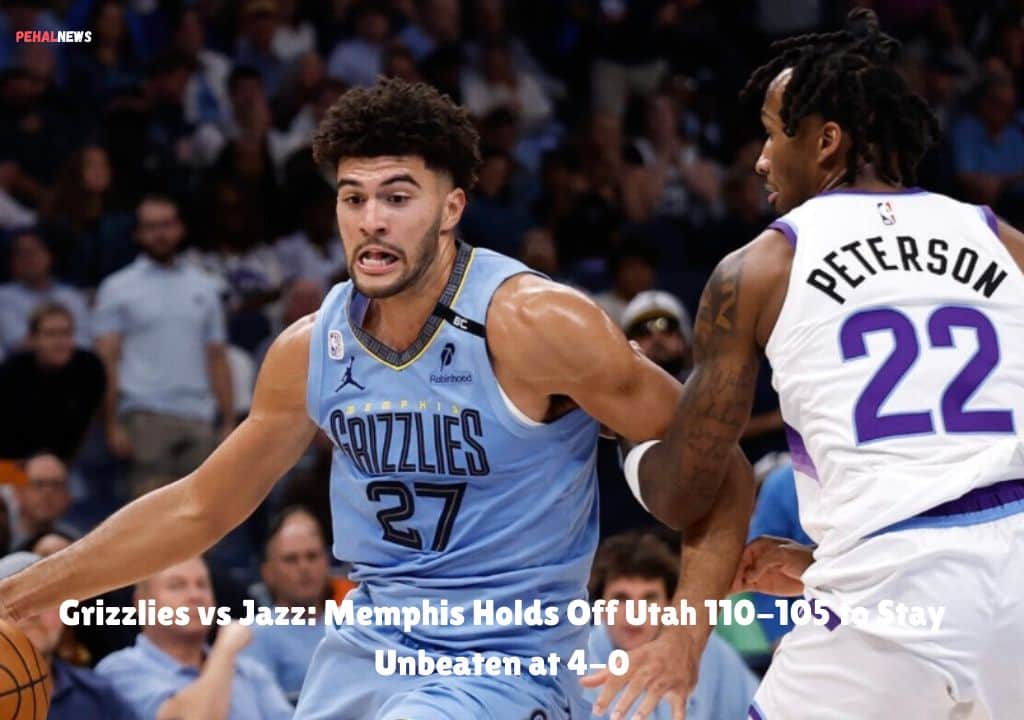
Grizzlies vs Jazz ended with Memphis protecting a narrow 110-105 victory on Monday, October 26, 2026, extending the team’s winning start to the NBA season to four games. The Grizzlies defeated Utah at the Delta Center in Salt Lake City, overcoming a determined fourth-quarter push from the home team to maintain their unbeaten record.
The result moved Memphis to 4-0 in the 2026-27 season, while Utah fell to 1-3. The five-point margin reflected a competitive contest in which the Jazz won the rebounding battle and scored more points in the paint, but Memphis found the edge through perimeter shooting and accurate free throws.
Cedric Coward was a key contributor for the Grizzlies, finishing with 16 points and 11 rebounds. Jaylen Wells added 14 points, rookie Cameron Boozer scored 13, and Ty Jerome contributed 15 points and eight assists.
Utah received a game-high 26 points from Keyonte George. Rookie Ace Bailey added 17 points and 10 rebounds, while Mo Bamba scored 14 points and provided a strong presence around the basket.
The Grizzlies vs Jazz matchup was also a rematch of the teams’ season opener, which Memphis had won 123-103 on October 21. This second victory gave Memphis a 2-0 advantage over Utah in their early-season meetings.
The most revealing part of the result was how Memphis won. Utah collected more rebounds and scored more points inside, yet the Grizzlies made 16 three-pointers and converted 20 of their 22 free throws. Those efficiencies helped Memphis withstand the Jazz’s late push.
Grizzlies vs Jazz Score: How the Game Unfolded
The Grizzlies vs Jazz score developed through four competitive quarters, with Memphis building an early cushion before Utah repeatedly attempted to close the gap.
| Quarter | Memphis Grizzlies | Utah Jazz |
| First | 30 | 21 |
| Second | 28 | 31 |
| Third | 31 | 24 |
| Fourth | 21 | 29 |
| Final | 110 | 105 |
Memphis opened strongly, scoring 30 points in the first quarter while holding Utah to 21. The early advantage gave the visitors room to manage the game, but the Jazz responded with a 31-point second quarter and narrowed the difference before halftime.
The third quarter proved important. Memphis scored 31 points while limiting Utah to 24, rebuilding its cushion and creating separation heading into the final period.
The Jazz refused to surrender. Utah produced 29 points in the fourth quarter, compared with 21 for Memphis, bringing the contest back into striking distance. However, the Grizzlies had established enough of a lead to survive the comeback attempt.
The Grizzlies vs Jazz finish demonstrated why a strong third quarter can matter in a close NBA contest. Memphis did not dominate every stretch, but its scoring burst before the fourth quarter gave the team a margin it could defend.
For Utah, the comeback showed resilience but also highlighted how expensive the early deficit had become. The Jazz needed to play from behind for much of the game, and their late improvement ultimately fell five points short.
Cedric Coward Records a Double-Double for Memphis
Cedric Coward delivered one of the most important individual performances in the Grizzlies vs Jazz game, finishing with 16 points, 11 rebounds and three assists.
The double-double reflected his contribution at both ends of the floor. Coward helped Memphis secure possessions, converted scoring opportunities and provided a consistent presence while Utah attempted to close the gap.
Coward also made all four of his three-point attempts. That perfect long-range shooting was significant in a game where perimeter efficiency separated the teams. His outside accuracy forced the Jazz to respect him beyond the arc instead of concentrating entirely on players closer to the basket.
Memphis needed contributions from several players rather than relying on one scorer to carry the offence. Coward’s combination of rebounding and shooting helped deliver that balance.
Jaylen Wells contributed another 14 points, shooting five of nine from the field, while Cameron Boozer added 13 points, seven rebounds and four assists. Jerami Grant also finished with 13 points, giving Memphis another source of scoring.
Quinten Post added 12 points off the bench, providing another useful contribution in a game decided by only five points.
The Grizzlies vs Jazz result showed the value of a collective performance. Coward’s double-double stood out, but Memphis also benefited from its supporting players converting opportunities and keeping the offense productive across different lineups.
That balance could be valuable as the season continues. Teams that receive reliable contributions from several players have more ways to respond when a leading scorer has an off night.
Ty Jerome Controls the Offence With 15 Points and Eight Assists
Ty Jerome continued to play an important role in Memphis’ early-season success, finishing the Grizzlies vs Jazz matchup with 15 points and eight assists.
Jerome entered the game following an impressive scoring run. He had scored 45 points in Memphis’ season opener against Utah and added 31 points in the subsequent victory over Sacramento. His output had been central to the team’s unbeaten start.
Against Utah on October 26, Jerome’s scoring was more restrained, but he contributed as a playmaker. Eight assists helped Memphis create opportunities for teammates and maintain offensive movement through different phases of the game.
That difference matters because a productive point guard does not always need to lead the team in scoring. Jerome’s ability to distribute the ball can help Coward, Wells, Boozer and other contributors find better opportunities.
Memphis has also needed Jerome to provide stability at point guard following Ja Morant’s offseason departure. The early results have offered encouragement, although the season remains young and opposing teams will continue adjusting to his role.
The Grizzlies vs Jazz contest tested Memphis’ ability to produce without requiring Jerome to repeat his extraordinary 45-point performance. The team passed that test by spreading its scoring across the lineup.
Jerome’s eight assists were especially useful in a game where Memphis made 16 three-pointers. Moving the ball and finding open shooters helped the Grizzlies take advantage of their perimeter opportunities.
His performance was another example of how Memphis can win through varied offensive contributions rather than one player shouldering the entire scoring burden.
Keyonte George Leads Utah With 26 Points
Keyonte George was the leading scorer in the Grizzlies vs Jazz game, recording 26 points and six assists for Utah.
George provided the offensive production the Jazz needed to remain competitive. He made nine of 17 field-goal attempts and eight of nine free throws, showing an ability to score from the field and earn points at the line.
His performance was especially important because Utah needed to make up ground after Memphis’ strong first quarter and third-quarter scoring run. George helped the home team remain within reach, but the Jazz could not overcome the full deficit.
Ace Bailey delivered another encouraging performance, recording 17 points, 10 rebounds and three assists. The rookie’s double-double demonstrated his ability to contribute on the glass as well as through scoring.
Mo Bamba added 14 points, seven rebounds and four blocks. Darryn Peterson also scored 14 points, giving Utah multiple players capable of producing offence.
The Grizzlies vs Jazz result was therefore not a case of Utah lacking individual scoring performances. George led the way, and Bailey, Bamba and Peterson added useful contributions.
The difference was that Memphis made better use of its long-range chances and free throws. Utah’s top scorers kept the team in the contest, but the overall shooting numbers left the Jazz needing more points in the closing minutes.
George’s performance still offered a positive sign for Utah. His ability to score and create opportunities will be important as the team continues developing its young roster.
Three-Point Shooting Gives Memphis the Edge
One of the clearest explanations for the Grizzlies vs Jazz outcome was Memphis’ advantage from beyond the three-point line.
The Grizzlies made 16 of 37 three-point attempts, approximately 43%. Utah made 10 of 33, approximately 30%.
That difference meant Memphis connected on six more three-pointers. Because each successful shot from beyond the arc is worth three points, the gap represented 18 points from made three-pointers before accounting for the teams’ other scoring.
Memphis also shot 20 of 22 from the free-throw line, converting approximately 91% of its attempts. Utah made 19 of 25 free throws, approximately 76%.
The Jazz had more rebounds, collecting 49 compared with Memphis’ 43, and scored 46 points in the paint against 34 for the Grizzlies. Utah also recorded eight blocks, twice Memphis’ four.
Those advantages did not translate into a victory because the Grizzlies were more efficient in other scoring areas. Memphis made 37 of 85 field-goal attempts overall, while Utah made 38 of 92. The difference in total field goals was small, but Memphis’ greater number of three-pointers provided a substantial scoring advantage.
The Grizzlies vs Jazz statistics illustrate how teams can win without controlling every category. Utah had advantages near the basket and on the boards, yet Memphis’ perimeter shooting and free-throw accuracy proved more decisive.
The postgame box-score thread includes the detailed scoring and team statistics.
Why Utah’s Fourth-Quarter Rally Was Not Enough
Utah improved its scoring in the final quarter, putting up 29 points and cutting into Memphis’ advantage.
The Jazz had several reasons to believe they could make the game closer. George was producing points, Bailey was contributing on the boards, and Utah had already shown it could score inside.
However, the Grizzlies had built their lead through a strong opening quarter and another scoring advantage in the third. Utah was forced to spend the final period chasing the game rather than playing from level ground.
The Grizzlies vs Jazz fourth quarter was a reminder that a late rally has to overcome not only the opposing defence but also the points accumulated earlier in the game.
Memphis needed to avoid giving away possessions and make its free throws when opportunities arose. The team’s 20-of-22 performance from the line across the game gave it a reliable source of points.
Utah’s fourth-quarter improvement will offer some encouragement, but the Jazz will need to find ways to start games more consistently. Giving away an early cushion places pressure on the offence and makes every late possession more consequential.
The five-point finish also means the result was not comfortable for Memphis. The Grizzlies will want to maintain their shooting efficiency while continuing to improve their rebounding and defence.
Grizzlies vs Jazz: Memphis Moves to 4-0
The Grizzlies vs Jazz victory extended Memphis’ record to 4-0, marking an encouraging start to the team’s 2026-27 campaign.
Memphis had already defeated Utah 123-103 in its season opener, followed by victories over Golden State and Sacramento. The second win over Utah continued the unbeaten run and gave the Grizzlies a 2-0 advantage in the season series between the teams.
Ty Jerome’s scoring, Coward’s rebounding and the contributions of younger players such as Boozer have helped Memphis produce results early in the season. The team has demonstrated that it can win through different routes, including high-scoring performances and closer contests that require late-game composure.
The next challenge is sustaining that form. Four wins do not determine the outcome of a long NBA season, and Memphis will face different opponents, lineups and defensive approaches in the weeks ahead.
The Grizzlies vs Jazz victory nevertheless offers a useful example of the team’s current strengths. Memphis shot well from outside, distributed scoring across several players and protected its advantage after Utah made a late push.
Utah, meanwhile, fell to 1-3. The Jazz have shown offensive potential through George and Bailey, but the team needs to improve its shooting consistency and avoid falling into large early deficits.
For both teams, the game provides material for adjustments rather than a final judgment on their seasons.
What Comes Next for the Grizzlies and Jazz?
Memphis is scheduled to visit the Portland Trail Blazers on Thursday, October 29, while Utah is scheduled to host the San Antonio Spurs on Wednesday, October 28, according to the teams’ early-season schedule.
The Grizzlies will aim to carry their unbeaten momentum into the next game. Maintaining the shooting form seen against Utah could help, but Memphis will also need to continue defending the paint and competing for rebounds.
The Jazz have a shorter turnaround. Their next opportunity will be to build on George’s scoring performance and Bailey’s double-double while improving their efficiency from three-point range.
The Grizzlies vs Jazz matchup has already provided an early-season measuring point for both teams. Memphis can take confidence from reaching 4-0, while Utah can study the statistical gap that decided a close game.
The next games will show how both teams respond. Memphis needs to sustain its balance; Utah needs to convert more of its opportunities into points.
Frequently Asked Questions About Grizzlies vs Jazz
What was the final score of Grizzlies vs Jazz?
Memphis defeated Utah 110-105 on October 26, 2026, at the Delta Center in Salt Lake City.
Who led Memphis in scoring?
Cedric Coward led the Grizzlies with 16 points and 11 rebounds. Jaylen Wells scored 14, while Cameron Boozer and Jerami Grant each added 13 points.
Who was Utah’s top scorer?
Keyonte George led all players with 26 points and added six assists. Ace Bailey recorded 17 points and 10 rebounds.
What is Memphis’ record after Grizzlies vs Jazz?
Memphis improved to 4-0, extending its unbeaten start to the 2026-27 season.
What is Utah’s record after the game?
Utah dropped to 1-3 after its second loss to Memphis in the opening week of the season.
What was the key statistical difference?
Memphis made 16 three-pointers compared with Utah’s 10 and converted 91% of its free throws, compared with Utah’s 76%. Those differences helped the Grizzlies win despite being out-rebounded.
Conclusion: Grizzlies vs Jazz Highlights Memphis’ Shooting and Team Balance
The Grizzlies vs Jazz game ended with Memphis earning a 110-105 road victory and extending its winning streak to four games. Cedric Coward’s double-double, Ty Jerome’s playmaking and contributions from several other players helped the Grizzlies withstand Utah’s late challenge.
Keyonte George led Utah with 26 points, while Ace Bailey recorded a double-double of his own. The Jazz won the rebounding battle and scored more points in the paint, but Memphis’ three-point shooting and free-throw accuracy proved decisive.
The Grizzlies vs Jazz result also continued a strong start for Memphis, which had already beaten Utah in the season opener. For the Jazz, the defeat underlined the importance of more consistent shooting and stronger starts.
The result is an encouraging milestone for Memphis, but the season remains in its early stages. The Grizzlies will need to maintain their balance and execution, while Utah will look to turn individual scoring performances into more wins.
For now, Memphis leaves Salt Lake City at 4-0 after a disciplined performance in a close game. The Grizzlies vs Jazz rematch showed that efficient shooting can make the difference even when an opponent wins the battle inside.