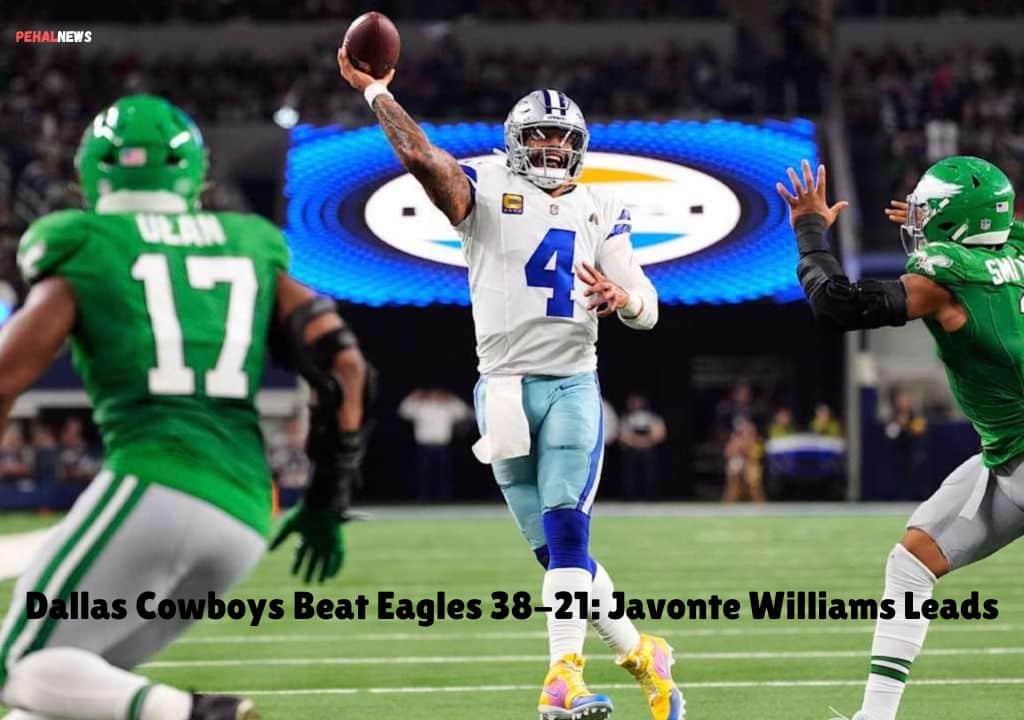
The Dallas Cowboys delivered one of their most productive offensive performances of the season by defeating the Philadelphia Eagles 38-21 on Monday night, October 26, 2026. Dallas combined an effective running game with important passing touchdowns to revive its offence, while Philadelphia struggled to contain the visitors at Lincoln Financial Field.
The result was significant for the Dallas Cowboys after consecutive defeats had raised questions about the team’s offensive consistency. Entering the game at 2-4, Dallas had scored only 29 combined points in its previous two losses. The victory improved the Cowboys to 3-4 and gave them a positive start to the week ahead of their next home game.
Philadelphia, meanwhile, fell to 2-5 and extended its losing streak to five games, its longest since the 2016 season, according to Bleeding Green Nation’s postgame recap.
The Dallas Cowboys vs Eagles contest featured several shifts in momentum. The Eagles scored touchdowns on their first two offensive drives and took a 21-20 lead early in the third quarter. Dallas responded with a touchdown pass to CeeDee Lamb and a successful two-point conversion by Dak Prescott, then added a field goal and a late rushing touchdown to secure the 17-point win.
Running back Javonte Williams was a major part of the turnaround, rushing for 132 yards as the Dallas Cowboys finished with 204 rushing yards and 416 total offensive yards.
The victory did not resolve every issue facing Dallas, particularly on defence, but it demonstrated how a productive ground game and timely scoring can make a difference against a divisional rival.
Javonte Williams Leads the Dallas Cowboys Rushing Attack
Javonte Williams delivered a standout performance against Philadelphia, giving the Dallas Cowboys the balanced offensive approach they had been seeking.
Williams rushed for 132 yards, according to the postgame coverage, as Dallas repeatedly found space against an Eagles defence that entered the matchup with questions about its ability to stop the run.
The Dallas Cowboys had struggled to establish a consistent rushing attack earlier in the season. Before the game, their ground production had been among the league’s weaker marks, forcing the offence to rely heavily on Prescott’s passing.
That changed against Philadelphia. The Cowboys ran effectively on early downs, moved the chains and made the Eagles defend the full width of the field. By keeping the rushing threat active, Dallas created more favourable passing opportunities for Lamb and Pickens.
The running game also helped Dallas control key stretches of the contest. Rather than asking Prescott to deliver on every possession, the Dallas Cowboys were able to stay balanced and keep the Philadelphia defence guessing about what would come next.
The team finished with 204 rushing yards, compared with 121 for the Eagles. That advantage was important in a game where the visitors needed to respond after Philadelphia briefly took the lead in the third quarter.
Williams’ production was also valuable in the closing stages. Dallas used the ground game to move into scoring territory late in the fourth quarter before adding the touchdown that established the final 38-21 margin.
The result gives the Dallas Cowboys a positive blueprint for the coming weeks: establish the run early, protect the quarterback and use the passing game to capitalise when opposing defences commit more players to stopping the ground attack.
Dak Prescott and CeeDee Lamb Deliver Crucial Touchdowns
Quarterback Dak Prescott and receiver CeeDee Lamb played important roles in the Dallas Cowboys victory.
Lamb scored a touchdown in the first quarter to help Dallas answer Philadelphia’s initial score. Later, after the Eagles had taken a 21-20 advantage, Prescott found Lamb again for a touchdown that put the Cowboys back in front.
Prescott then ran in the successful two-point conversion, extending the Dallas lead to 28-21.
That sequence was the turning point of the Dallas Cowboys vs Eagles game. Philadelphia had completed a lengthy touchdown drive to start the second half and briefly appeared to have taken control. Dallas responded with a scoring drive that restored its advantage and put pressure back on the home team.
The connection between Prescott and Lamb has been a central part of the Dallas passing attack. When Lamb is available and producing consistently, opposing defences must account for his routes and ability to create separation. That attention can help open opportunities for other receivers and the running game.
George Pickens provided another important moment before halftime. Prescott connected with Pickens for a touchdown after Dallas sustained a long drive, giving the visitors a 17-14 lead at the time.
The Dallas Cowboys added a field goal before halftime, entering the break ahead 20-14. That late first-half score helped them maintain a narrow advantage despite Philadelphia’s early offensive success.
Prescott’s key plays were not limited to long throws. He also used his legs on the two-point conversion, helping the Dallas Cowboys take advantage of an opportunity that proved valuable in a game where the lead changed hands.
The overall performance showed the importance of distributing the ball to multiple playmakers rather than relying on a single receiver to carry the attack.
George Pickens Adds Another Important Scoring Threat
George Pickens provided a key contribution by catching a touchdown pass from Prescott in the second quarter.
The scoring play capped a long Dallas possession that involved several first-down conversions and forced Philadelphia to defend for an extended period. Pickens made the catch near the right side of the end zone, giving the Dallas Cowboys a 17-14 lead.
The reception was significant because it came during a period when Philadelphia’s offence was also finding opportunities. The Eagles had scored two touchdowns and were putting pressure on the Dallas defence, making it important for the visitors to continue producing points.
Pickens’ contribution demonstrated the value of having more than one reliable target in the passing game. While Lamb attracted attention and made scoring plays, Pickens gave Prescott another option in the red zone.
The Dallas Cowboys need that variety as they move deeper into the season. When opponents devote extra attention to Lamb or attempt to pressure Prescott, receivers such as Pickens can create opportunities to punish defensive coverage mistakes.
Dallas also benefited from the work of its offensive line. The team maintained its composure on long drives, converted important situations and created room for both the passing attack and the running game.
The Dallas Cowboys vs Eagles result was therefore not just a story about one explosive player. It was a collective offensive performance in which multiple players contributed at crucial moments.
How the Eagles Took a Third-Quarter Lead
Although Dallas ultimately won comfortably, the Dallas Cowboys did not have control of the game throughout.
Philadelphia started strongly and scored a touchdown through Saquon Barkley during its opening possession. The Cowboys responded with Lamb’s touchdown, but the Eagles struck again through Dameon Pierce to move ahead 14-10.
Pickens’ touchdown and a Dallas field goal moved the visitors ahead 20-14 at halftime. Philadelphia then produced a long opening drive in the third quarter, with quarterback Tanner McKee connecting with rookie receiver Makai Lemon for a touchdown.
The score moved the Eagles ahead 21-20 and threatened to change the momentum of the game.
McKee was starting in place of Philadelphia’s usual quarterback, Jalen Hurts, who was unavailable for this matchup. Despite using a backup, the Eagles demonstrated that they could move the ball effectively on several early drives.
The touchdown to Lemon capped a sustained possession that consumed more than nine minutes of the third quarter, giving Philadelphia an opportunity to control both the scoreboard and the clock.
But the Dallas Cowboys responded immediately. Prescott’s touchdown pass to Lamb and the ensuing two-point conversion restored the lead. That response prevented Philadelphia from turning its third-quarter scoring drive into a decisive advantage.
The game illustrated why momentum in the NFL can shift rapidly. One long possession helped the Eagles move in front, but Dallas answered with a decisive scoring drive of its own.
Philadelphia’s Defensive Problems Become the Main Story
The Dallas Cowboys produced 416 total yards, including 212 passing yards and 204 rushing yards. Philadelphia finished with 321 total yards, including 200 passing yards and 121 rushing yards.
The Cowboys’ ground production placed particular pressure on the Eagles. Dallas was able to sustain drives, create favourable down-and-distance situations and keep the Philadelphia defence on the field for extended periods.
The Eagles’ defensive front struggled to disrupt Prescott. Bleeding Green Nation reported that Philadelphia recorded no tackles for loss, sacks or quarterback hits during the game.
That lack of pressure gave the Dallas Cowboys time to develop plays and make important throws. It also allowed the offensive line to maintain a more comfortable environment for the quarterback.
Philadelphia’s defence had difficulty ending Dallas drives before they reached scoring range. The Cowboys converted eight of 13 third-down opportunities and scored on three of five red-zone trips, according to the available game statistics.
The Eagles had their own productive offensive moments, but those performances could not compensate for the points conceded on defence.
One of the more damaging sequences for Philadelphia occurred in the second half. After the Cowboys regained the lead, Dallas added a field goal to make it 31-21. Philadelphia then surrendered possession when McKee was intercepted by linebacker DeMarvion Overshown.
The turnover gave Dallas an opportunity to manage the closing minutes. The Cowboys eventually reached the end zone again, establishing the final 38-21 score.
For the Eagles, the defeat raises questions about defensive pressure, tackling and the ability to stop the run. For Dallas, the challenge now is to build on the offensive improvements while addressing the defensive mistakes that allowed Philadelphia to score 21 points.
DeMarvion Overshown’s Interception Helps Dallas Close the Game
The Dallas Cowboys defence played an important role late in the fourth quarter when DeMarvion Overshown intercepted McKee.
Philadelphia needed a response after falling behind 31-21. The Eagles had shown earlier that they could sustain drives, but the interception ended the possession and handed Dallas another opportunity to control the game.
The turnover mattered because Philadelphia was still within reach of making the final minutes competitive. With the Eagles trailing by 10 points, another scoring drive could have increased the pressure on the Cowboys.
Instead, Overshown’s play gave Dallas a chance to extend its lead. The Dallas Cowboys moved into scoring position and finished the drive with a rushing touchdown, bringing the final score to 38-21.
Dallas ended the game without a turnover of its own, while Philadelphia committed one interception. Protecting the ball was important in a contest where the Cowboys had already established a significant offensive advantage.
The interception also underlined the importance of defensive contributions in a game dominated by offensive statistics. Dallas needed a timely stop to ensure that Philadelphia could not build another comeback.
For the Dallas Cowboys, the play helped turn a competitive game into a more decisive result.
What the Victory Means for the Dallas Cowboys’ Season
The Dallas Cowboys improved to 3-4 after the victory, while Philadelphia fell to 2-5.
The result is important because Dallas had entered the matchup after consecutive losses to Tampa Bay and Green Bay. Those defeats had created pressure on the offence to find a more reliable approach.
Against Philadelphia, the Dallas Cowboys scored 38 points and produced more than 400 yards of offence. Williams’ rushing performance, Prescott’s touchdown passes and the team’s ability to convert scoring opportunities gave the Cowboys a much-needed response.
The win does not guarantee a successful season or settle the NFC East race, but it offers Dallas a platform to build on. The team will need to demonstrate similar consistency in its upcoming games and improve its defence if it hopes to remain competitive in the division.
Philadelphia now faces a different challenge. Five consecutive defeats have left the Eagles searching for a way to stop the slide. Their offence showed some encouraging signs with McKee at quarterback, but the defence needs to reduce the number of long drives and scoring opportunities it allows.
The Dallas Cowboys vs Eagles rivalry remains one of the NFL’s most closely watched divisional matchups, and the result will shape the conversation around both teams in the coming week.
Dallas Cowboys Next Game: Arizona Cardinals on November 1
The Dallas Cowboys are scheduled to host the Arizona Cardinals on Sunday, November 1, at AT&T Stadium. Kickoff is set for 1 p.m. Eastern Time, according to the NFL’s official Cowboys schedule.
The Cardinals will provide another test for a Dallas team seeking to turn one strong performance into a more consistent run of results.
For the Dallas Cowboys, the priority will be maintaining the improved rushing attack while continuing to protect Prescott and keep multiple receivers involved. The team will also need to address the defensive lapses that allowed Philadelphia to score touchdowns on its first two drives and again at the start of the third quarter.
The Cowboys’ victory creates some momentum, but the next game will show whether the offensive revival can be sustained.
Frequently Asked Questions About the Dallas Cowboys
What was the final score of Cowboys vs Eagles?
The Dallas Cowboys defeated the Philadelphia Eagles 38-21 on Monday, October 26, 2026, at Lincoln Financial Field in Philadelphia.
How many rushing yards did Javonte Williams record?
Williams rushed for 132 yards, leading a Dallas Cowboys ground attack that produced 204 team rushing yards.
How did Dak Prescott perform against Philadelphia?
Prescott connected with CeeDee Lamb for two touchdown passes, found George Pickens for another touchdown, and completed a successful two-point conversion with a run.
What is the Dallas Cowboys’ record after the Eagles game?
Dallas improved to 3-4 following the victory. Philadelphia dropped to 2-5 and extended its losing streak to five games.
When do the Dallas Cowboys play next?
Dallas is scheduled to host the Arizona Cardinals on Sunday, November 1, 2026, at AT&T Stadium.
Why was the Cowboys’ running game important?
The running game produced 204 yards and helped Dallas control possessions, sustain drives and create better passing opportunities for Prescott.
Conclusion: Dallas Cowboys Deliver a Much-Needed Offensive Response
The Dallas Cowboys produced a convincing 38-21 win over the Philadelphia Eagles, combining an effective running attack with timely passing touchdowns to claim an important divisional victory.
Javonte Williams led the ground game with 132 yards, while Prescott connected with Lamb and Pickens for touchdowns. The Dallas Cowboys also benefited from an interception by Overshown and a defence that made a decisive play in the fourth quarter.
Philadelphia showed early promise, taking a 21-20 lead shortly after halftime, but the Cowboys responded with a touchdown and two-point conversion before adding a field goal and a late rushing score.
The victory moved Dallas to 3-4 and gave the team a chance to build momentum ahead of its November 1 meeting with Arizona. For Philadelphia, the five-game losing streak makes defensive improvement an urgent priority.
The Dallas Cowboys have taken an important step towards recovering from their recent struggles, but consistency will matter more than one result. The next few weeks will show whether the victory over the Eagles marks a lasting change in the team’s offensive performance.