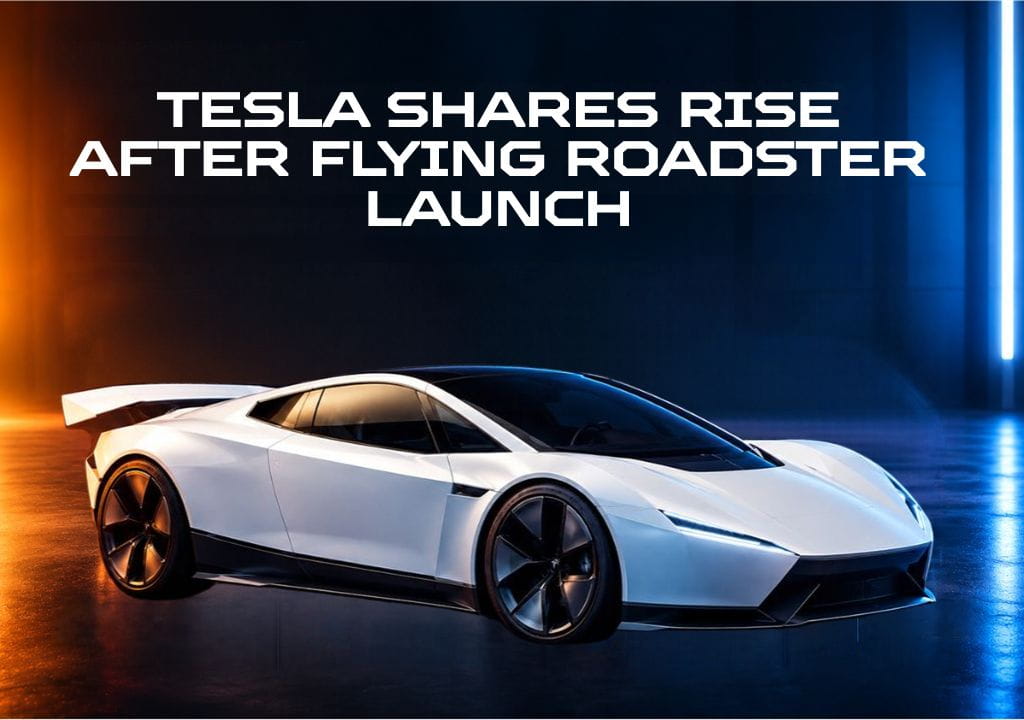
Tesla shares rise after flying Roadster launch became a major talking point in financial and automotive news after the electric vehicle company unveiled a redesigned version of its long-awaited Roadster. The dramatic demonstration featured a white electric sports car performing short airborne manoeuvres using rocket-style thrusters developed in collaboration with SpaceX.
The October 15, 2026, event attracted attention because it showcased a vehicle that goes beyond the conventional expectations of an electric sports car. Rather than focusing only on acceleration, range and styling, Tesla presented a concept built around advanced propulsion technology and futuristic performance.
Investors initially responded positively. Reuters reported that Tesla shares rose about 5% in premarket trading on Friday, October 16, following the reveal. However, the stock did not maintain those gains throughout the session, and later reports described a reversal as broader technology-market pressure weighed on shares.
The changing reaction is important. Tesla shares rise after flying Roadster launch reflects the initial enthusiasm surrounding an ambitious product, but the subsequent reversal demonstrates that investors still want evidence of commercial progress.
The new Roadster is scheduled to enter production in 2028, more than a decade after Tesla first presented its next-generation sports car in 2017. The company has not yet provided all the details investors would need to estimate its eventual sales volume or financial contribution.
For Tesla, the launch is therefore both a technology showcase and a test of whether an ambitious product announcement can restore investor confidence.
What Is Tesla’s New Flying Roadster?
The redesigned Tesla Roadster is a high-performance electric sports car developed with technology associated with SpaceX, the aerospace company led by Elon Musk.
During the Texas demonstration, the vehicle used cold-gas thrusters to perform brief airborne manoeuvres. It was shown turning in mid-air, correcting its orientation and landing on a test track. The presentation also included a demonstration involving an inverted ramp and a specialised suction system.
These features helped distinguish the Roadster from conventional performance cars. Most electric sports cars compete through acceleration, battery technology, handling and range. Tesla’s demonstration instead highlighted the possibility of combining automotive engineering with aerospace-inspired propulsion.
The company described the vehicle as capable of exceptional acceleration and advanced manoeuvres. However, a demonstration does not establish how the system would perform under ordinary driving conditions, how much it would cost to maintain or whether the technology could meet requirements for public-road use.
The vehicle’s airborne capabilities should not be confused with unrestricted flight. Tesla’s rocket-equipped version is described as invitation-only and is not approved for public-road use in that configuration, according to reporting by The Washington Post.
The headline Tesla shares rise after flying Roadster launch therefore refers to a dramatic demonstration of a specialised vehicle, not the arrival of a conventional flying car that consumers can immediately purchase and use anywhere.
Why Tesla Shares Rose After the Roadster Reveal
The initial rise in Tesla shares reflected several possible factors, including investor enthusiasm for new technology, the publicity surrounding the demonstration and expectations about the company’s long-term strategy.
1. A powerful technology showcase
Tesla has built much of its identity around ambitious engineering and the idea that electric vehicles can offer capabilities beyond traditional cars.
The Roadster reveal reinforced that identity. Its unusual demonstration generated attention across automotive, technology and financial media, placing Tesla back at the centre of discussions about future mobility.
For investors, a technology showcase can matter even when the product is not expected to generate significant near-term revenue. It may strengthen the company’s brand, attract attention from potential customers and reinforce expectations about future innovation.
This helps explain why Tesla shares rise after flying Roadster launch became a widely discussed headline even though the production version remains years away.
2. The Tesla-SpaceX connection
The Roadster also highlighted the engineering relationship between Tesla and SpaceX.
SpaceX specialises in aerospace technology, while Tesla focuses on electric vehicles, energy systems and related technologies. Combining their expertise for a dramatic demonstration created a compelling story about the potential overlap between the businesses.
Some market commentators interpreted the reveal as another reason to discuss a possible closer corporate relationship between the companies. However, speculation about a merger should not be treated as confirmation: no completed merger has been announced.
For investors, the practical question is whether cooperation produces measurable technological or financial benefits rather than simply generating publicity.
3. Renewed attention on Tesla’s future
Tesla has increasingly emphasised autonomous driving, artificial intelligence and robotics alongside electric vehicles.
The Roadster provides a high-profile example of the company’s willingness to pursue ambitious engineering projects. It can attract attention to Tesla’s broader vision even if the vehicle itself is produced in relatively small numbers.
Nevertheless, investor enthusiasm is not the same as financial performance. A successful demonstration must eventually be followed by engineering validation, production planning, customer deliveries and reliable commercial results.
Why Tesla Shares Later Reversed
The initial enthusiasm did not translate into a sustained stock-market rally. Reporting on October 16 indicated that Tesla shares gave back their early gains and fell during the session.
Several factors help explain the more cautious reaction.
First, the Roadster will not enter production until 2028 under Tesla’s current plan. That means any meaningful contribution to revenue is still some distance away.
Second, Tesla has not disclosed a complete set of production-volume and final-pricing details that would allow investors to estimate the project’s potential financial contribution.
Third, the company faces broader challenges in its electric-vehicle business. Its stock valuation reflects expectations about more than vehicle sales, including autonomous-driving technology, artificial intelligence and robotics. A dramatic sports-car launch cannot independently resolve questions about profitability or execution.
Finally, wider market movements also matter. Tesla shares can move with technology-sector sentiment, interest-rate expectations and changes in investor appetite for growth stocks.
The changing price action shows why the phrase Tesla shares rise after flying Roadster launch needs context. Shares initially advanced, but the move was not sustained throughout the trading session. A product announcement can influence sentiment without changing the underlying financial outlook immediately.
Tesla Roadster Performance: What Has the Company Claimed?
Tesla has promoted ambitious performance figures for the redesigned Roadster. These remain manufacturer claims that must be assessed against production specifications and independent testing.
The company has cited acceleration from zero to 60 miles per hour in less than one second, a top speed exceeding 230 mph and a driving range of more than 300 miles per charge.
These figures would place the Roadster among the most ambitious performance vehicles in the market if they are achieved in a production-ready version under clearly defined testing conditions.
However, performance figures require careful interpretation. Acceleration depends on the conditions of measurement, including traction, tyres, surface quality and the configuration of the vehicle. A demonstration using specialised thrusters is also different from a standard road test.
The range claim will need to be assessed using the final battery configuration and an established testing method. Similarly, the vehicle’s top speed, braking performance, thermal management and reliability will be important to customers considering an expensive sports car.
For now, investors should treat these specifications as targets or company claims rather than verified production results.
When Will the Tesla Roadster Be Available?
Tesla says production of the redesigned Roadster is planned for 2028. That schedule follows years of delays since the second-generation model was first revealed in 2017.
The extended development period is a significant part of the story. The original next-generation Roadster generated excitement through promises of extreme acceleration and high performance, but its anticipated delivery schedule repeatedly moved.
The latest demonstration provides a more substantial look at the vehicle’s intended capabilities, but it does not eliminate the risks associated with a future production programme.
Tesla will need to finalise engineering, validate safety systems, establish manufacturing processes and prepare vehicles for customer delivery. The specialised thruster-equipped configuration may also face additional regulatory and operational challenges.
Potential buyers should therefore distinguish between a public demonstration, a reservation and an actual production vehicle. A reservation does not guarantee an immediate delivery date, and the final specifications may differ from those shown during a presentation.
The Tesla shares rise after flying Roadster launch story will continue to evolve as the company provides clearer information about manufacturing, pricing and delivery schedules.
How Much Will the New Tesla Roadster Cost?
Tesla’s reservation information lists a $50,000 deposit for the Performance version and a $250,000 deposit for the Thrust version. A special Rocket configuration has been described as invitation-only.
These amounts are deposits rather than confirmed final retail prices. Tesla has not published a complete final pricing structure and production-volume plan for all versions.
The difference between the configurations is important. Buyers interested in the standard performance car should not assume that every vehicle will include the specialised thruster system demonstrated during the event.
The cost of maintaining the vehicle, insuring it and using specialised technology would also matter to prospective owners. The company will need to clarify the final equipment, warranty arrangements and practical limitations before customers can make an informed purchasing decision.
For Tesla, a premium Roadster could serve as a brand-building product, but its direct commercial impact will depend on how many vehicles can be produced and delivered profitably.
Is the Roadster a Real Flying Car?
The demonstration has encouraged headlines describing the Roadster as a flying car. That phrase captures the spectacle but can be misleading without an explanation of the technology.
The thruster-equipped vehicle was shown performing short airborne manoeuvres under controlled conditions. It was not demonstrated as a vehicle capable of routine, sustained flight over public roads.
A commercially usable flying car would face substantial challenges involving propulsion, stability, landing, passenger protection, noise, operating costs and aviation regulation.
The specialised version of the Roadster is not approved for public-road use in its demonstrated configuration. It would therefore be inaccurate to describe it as a normal road car that owners can simply drive into the air.
The distinction matters for both customers and investors. The demonstration shows an unusual engineering concept, but the practical market for such technology remains uncertain.
The Tesla shares rise after flying Roadster launch headline reflects excitement about the demonstration; it does not prove that mass-market flying cars are ready for everyday use.
What Does the Launch Mean for Tesla Investors?
The Roadster reveal could strengthen Tesla’s brand and generate interest in its engineering capabilities. But the vehicle is unlikely to be the only factor determining the company’s stock performance.
Investors will continue to watch vehicle deliveries, profit margins, cash flow, capital spending and the pace at which Tesla develops its autonomous-driving and robotics businesses.
The upcoming quarterly results and management commentary are especially important because they provide information about the company’s actual financial performance. A visually impressive product launch offers a different type of evidence from earnings, delivery figures or confirmed production milestones.
The Roadster could contribute to Tesla’s image as an innovative company, but its direct financial impact may be limited if production volumes remain small.
A sustained stock recovery would require investors to believe that the company’s long-term ambitions can translate into commercial results. That means monitoring both the Roadster programme and the wider business.
Investors should also remember that share prices are volatile and that a short-term reaction to a launch does not guarantee future gains. Anyone evaluating Tesla stock should consider their own financial circumstances and risk tolerance rather than relying on a headline.
Frequently Asked Questions
1. Why did Tesla shares rise after the flying Roadster launch?
Tesla shares initially rose after the company demonstrated the redesigned Roadster with SpaceX-inspired thrusters. The reveal generated enthusiasm about Tesla’s engineering capabilities and future technology strategy. The stock later gave back its early gains.
2. When was the new Tesla Roadster unveiled?
Tesla unveiled the redesigned Roadster at a SpaceX facility in Texas on October 15, 2026.
3. When will the Tesla Roadster enter production?
Tesla currently plans to begin production in 2028. Customer delivery timing and final production specifications remain subject to further announcements.
4. Can the new Tesla Roadster really fly?
The demonstration showed brief airborne manoeuvres using specialised thrusters. It was not a demonstration of unrestricted, sustained flight, and the thruster-equipped version is not approved for public-road use in that configuration.
5. What is the Tesla Roadster’s expected price?
Tesla’s reservation information lists deposits of $50,000 for the Performance version and $250,000 for the Thrust version. These are reservation deposits, not confirmed final retail prices.
6. Does the Roadster launch guarantee that Tesla shares will rise?
No. Stock prices depend on many factors, including earnings, delivery performance, market conditions and investor expectations. The initial rise after the reveal was followed by a reversal, illustrating the uncertainty.
7. Is the Roadster likely to transform Tesla’s revenue?
Its direct financial impact may be limited if it remains a low-volume premium vehicle. Its broader value may come from publicity and brand positioning, but the eventual contribution will depend on production, costs and demand.
Final Verdict: A Spectacular Reveal, but Execution Still Matters
Tesla shares rise after flying Roadster launch captured the excitement surrounding one of the company’s most dramatic product demonstrations in years. The redesigned Roadster showcased electric performance alongside aerospace-inspired thruster technology, generating attention from investors and the wider technology industry.
The initial market response was positive, but the subsequent reversal showed that enthusiasm alone does not settle questions about Tesla’s business outlook. Production is planned for 2028, final pricing remains incomplete and the specialised airborne configuration faces practical and regulatory limitations.
The Roadster may help Tesla maintain its reputation for ambitious engineering. Yet its long-term significance will depend on whether the company can turn the demonstration into a reliable production vehicle while continuing to deliver financial results across its wider business.
For investors, the next chapter will be determined less by the spectacle of the launch and more by measurable progress on production, sales, profitability and technology.